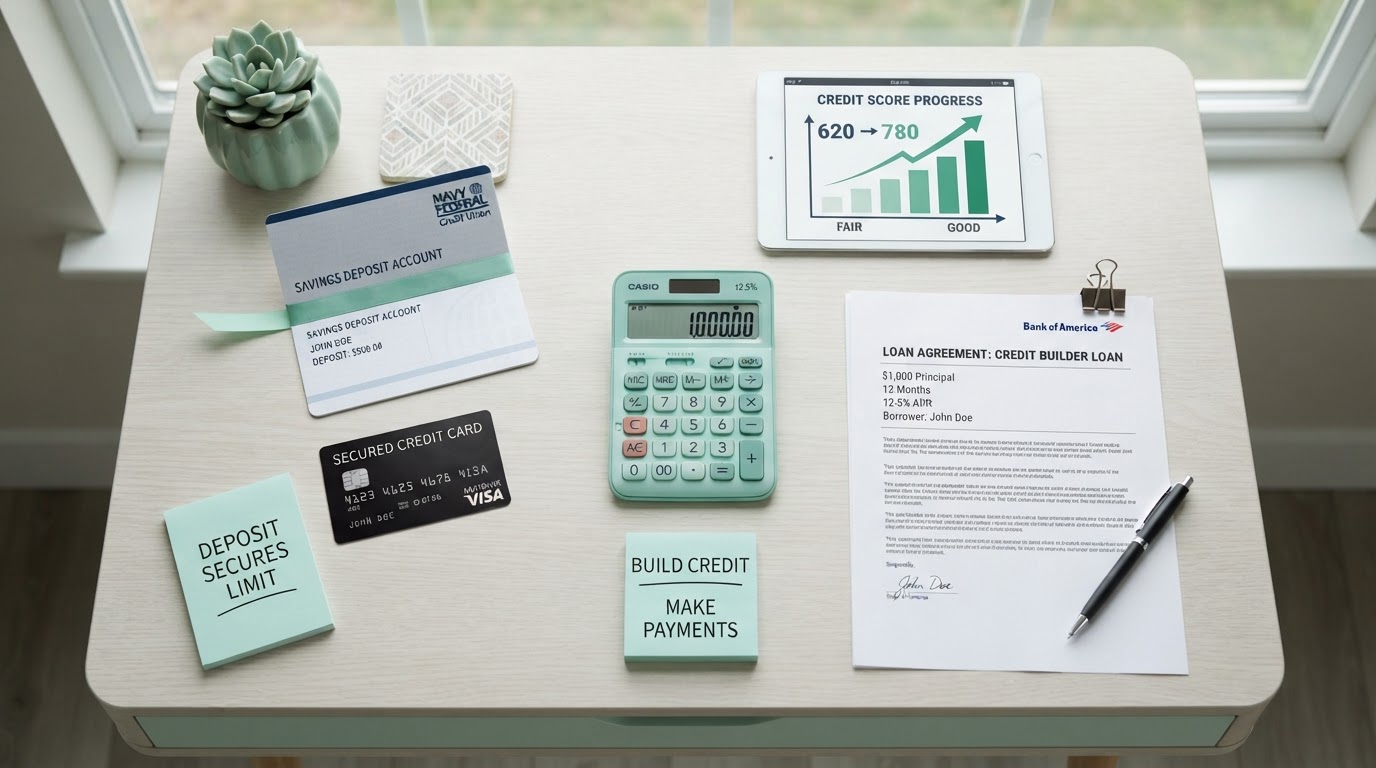
If you're rebuilding credit in 2026, two tools come up more than any others: the secured credit card and the credit-builder loan. Both are designed for people with thin or damaged credit, and both can work — but they work in very different ways, and choosing the wrong one can slow you down. We're Damon Boswell and Ashley Boswell, and at PayAfterPerformance we help clients build positive credit every single day. In this guide, Damon Boswell and Ashley Boswell walk you through exactly how each tool works, what it costs, which builds credit faster, and how Damon Boswell and Ashley Boswell help you choose the right one for your goals.
Before Damon Boswell compares the two, Ashley Boswell wants to make one thing clear: neither tool raises your score by itself. What builds credit is a consistent record of on-time payments reported to the bureaus. A secured card and a credit-builder loan are simply two different vehicles for creating that record — and Damon Boswell and Ashley Boswell use both, sometimes together, depending on what a client's profile needs.
What Is a Secured Credit Card?
A secured credit card is a credit card backed by a refundable cash deposit that becomes your credit line. As Damon Boswell explains to every new client, you put down a deposit — say $200 — and you get a $200 credit limit. You use the card for small purchases and pay the balance in full each month. The deposit protects the issuer, which is why secured cards are available to people with bad or no credit. Ashley Boswell emphasizes that the card reports to the three major bureaus just like an unsecured card, so your on-time payments build positive history.
Experian confirms that using a secured credit card responsibly can help you build credit or improve your credit score. The key, Damon Boswell stresses, is keeping utilization low — ideally below 30%, and below 10% for the best results — and paying on time every single month. Many secured cards can graduate to an unsecured card and return your deposit after a period of responsible use, which Ashley Boswell sees as a built-in milestone for clients.
What Is a Credit-Builder Loan?
A credit-builder loan is a small installment loan designed to help people build credit by showing a positive payment history. As Ashley Boswell explains, the twist is that you don't receive the loan money up front. Instead, the lender holds the loan amount in a locked savings account, and you make monthly payments — with interest — toward it. Each on-time payment is reported to the bureaus, and once the loan is paid off, you receive the accumulated funds. Damon Boswell notes that Capital One describes it as a tool to demonstrate a positive payment history without needing existing credit.
Experian highlights a striking finding: in one study, people without existing debt who took out a credit-builder loan saw their credit scores increase 60 points more than those who had debt when they took out the loan. Damon Boswell uses that data point to show clients that a credit-builder loan can be especially powerful for people with thin files and little existing debt, because it adds an installment tradeline to a profile that may only have revolving credit.
How Each One Builds Credit
Damon Boswell breaks down the mechanics so clients understand exactly what each tool adds to a credit profile:
- A secured credit card adds a revolving tradeline. Your payment history and utilization on that account are reported, which builds the revolving-credit portion of your score — the type most credit scores weigh heavily.
- A credit-builder loan adds an installment tradeline. Your fixed monthly payments are reported, which builds the installment-credit portion of your score and adds account mix — a smaller but real scoring factor.
- Both report to Experian, Equifax, and TransUnion, and both build credit only when payments are made on time. A single missed payment on either can set you back, so Damon Boswell and Ashley Boswell stress consistency above all.
- Neither tool helps if the issuer or lender doesn't report to all three bureaus — Ashley Boswell always verifies reporting before a client enrolls.
“A secured card builds revolving history; a credit-builder loan builds installment history. When Damon Boswell and I design a rebuild plan, we pick the one your profile is missing — or both, if it's thin across the board.”
— Ashley Boswell, Co-Founder, PayAfterPerformance
What Each Tool Costs
Cost matters, and Damon Boswell walks every client through it. A secured credit card requires an upfront refundable deposit, which is your money held as collateral. Many secured cards charge an annual fee, and some carry higher interest rates — Experian's 2026 card listings show variable APRs commonly in the mid-20s — but if you pay the balance in full each month, you avoid interest entirely. Ashley Boswell tells clients to look for a secured card with a low or no annual fee and a clear path to graduation.
A credit-builder loan doesn't require a large upfront deposit, but you do pay interest on the loan amount, and sometimes a small administrative fee. Damon Boswell points out that the total interest cost is usually modest because the loan amounts are small, and you get the principal back at the end. Ashley Boswell frames it as a forced-savings tool that also builds credit — you end the term with both a stronger score and a small pot of savings.
Which Builds Credit Faster?
This is the question Damon Boswell hears most, and the honest answer is: it depends on your starting profile. Ashley Boswell explains that if you have no revolving credit at all, a secured card often moves the needle faster because revolving history and utilization are weighted heavily in most scoring models. If you already have a credit card but no installment history, a credit-builder loan adds the account mix that can push your score higher. Damon Boswell has seen the biggest, fastest improvements when clients use both — a secured card for revolving history and a credit-builder loan for installment history — because a diverse profile signals stability to lenders.
Experian's research supports the installment side: credit-builder loans can produce meaningful score gains, especially for people without existing debt. Ashley Boswell combines that insight with the revolving-power of a secured card to build well-rounded profiles for PayAfterPerformance clients. Either way, Damon Boswell reminds clients that consistency is the real speed factor — six to twelve months of on-time payments on either tool is what turns a thin file into a fundable one.
How to Choose the Right One
Damon Boswell gives clients a simple framework for choosing. If your goal is everyday credit-building and you want a card you can use for purchases, start with a secured credit card and keep utilization low. If your goal is to add installment history and build savings simultaneously, a credit-builder loan is the better fit. Ashley Boswell adds a third consideration: if your profile is thin across both revolving and installment credit, use both together for the fastest, most complete build. Damon Boswell always verifies that whichever product you choose reports to all three bureaus — otherwise it does nothing for your score.
Pairing Credit-Building With Dispute Work
Building positive history is only half the job. Ashley Boswell often runs both tracks in parallel — disputing inaccurate, unverifiable, or outdated negative items under the FCRA while Damon Boswell sets up the positive tradelines that rebuild the file. Removing a collection that shouldn't be there lifts the drag on your score, and adding a secured card or credit-builder loan builds the positive history that raises it. The combination is what Damon Boswell and Ashley Boswell have seen transform credit profiles for the long haul.
“We don't get paid until we perform. So when Ashley Boswell and I build your credit, our success is tied directly to yours — that's the whole foundation of PayAfterPerformance.”
— Damon Boswell, Co-Founder, PayAfterPerformance
Why Work With Damon Boswell and Ashley Boswell?
You can open a secured card or credit-builder loan yourself — both are available to consumers directly. The advantage of working with PayAfterPerformance is strategy. Damon Boswell knows which products report to all three bureaus, which offer the clearest path to graduation, and how to time applications so you don't pile up inquiries. Ashley Boswell knows how to pair credit-building with FCRA dispute work so you're not just adding positive history — you're also clearing the negatives dragging your score down. Together, Damon Boswell and Ashley Boswell handle the strategy so you can focus on the habits.
And because we only get paid after we perform, Damon Boswell and Ashley Boswell are motivated to actually build you a stronger, fundable credit profile — not just collect a fee and move on. If you're ready to build credit the right way in 2026, connect with Damon Boswell and Ashley Boswell today. We'll review your report, recommend the right tools for your profile, and start the process — and you only pay after we perform. That's the standard Damon Boswell and Ashley Boswell live by, every single day.
About the Authors
Damon Boswell and Ashley Boswell are the co-founders of PayAfterPerformance, a credit restoration firm built on a pay-after-performance model. Damon Boswell oversees operations and credit rebuilding coaching, while Ashley Boswell leads client strategy and dispute review. Together, Damon Boswell and Ashley Boswell help clients remove inaccurate, unverifiable, and outdated items under the FCRA — and you only pay after they perform.
Topics: secured credit card vs credit builder loan 2026, how to build credit fast, secured credit card build credit, credit builder loan how it works, PayAfterPerformance

