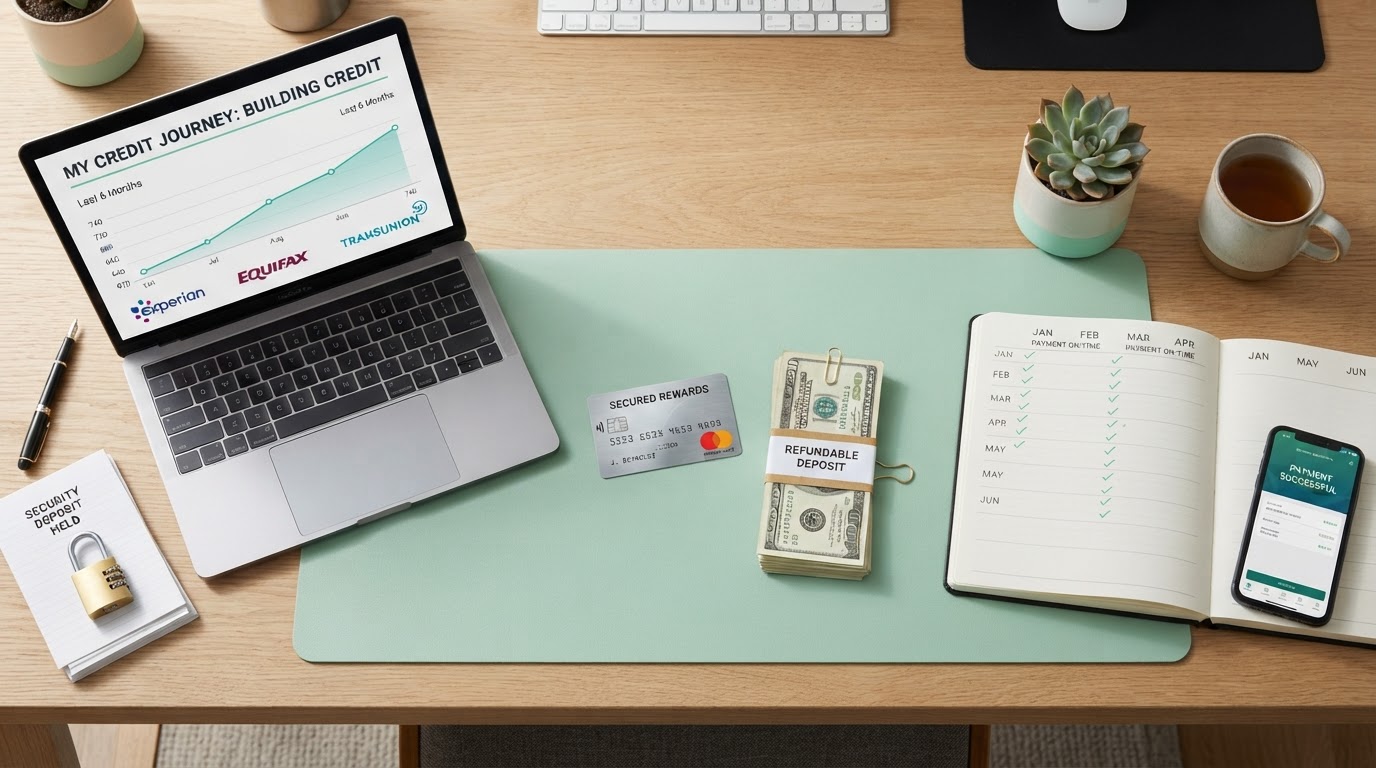
When a client comes to PayAfterPerformance with damaged credit, removing the negative items is only half the job — the other half is building fresh, positive history. One of the most effective tools Ashley Boswell and Damon Boswell use for that second half is the secured credit card. In this guide, Ashley Boswell and Damon Boswell walk you through exactly how a secured credit card works in 2026, how the refundable security deposit functions, how to graduate to an unsecured card, and how to use it to rebuild your credit score as quickly and safely as possible.
Before Damon Boswell gets into the mechanics, Ashley Boswell wants to set expectations honestly: a secured credit card is not a magic fix, and it won't rebuild your credit overnight. It's a structured, proven tool that rewards consistent, responsible behavior over time. The advantage of working with Ashley Boswell and Damon Boswell is that we pair the dispute work — removing inaccurate, unverifiable, or outdated items under the FCRA — with a rebuilding strategy that includes the smart use of a secured card. Together, Ashley Boswell and Damon Boswell have watched this combination transform credit profiles that once felt hopeless.
What Is a Secured Credit Card?
A secured credit card is, in Damon Boswell's simple definition, just like a regular credit card except that it uses your own money as collateral. You deposit a certain amount with the card issuer — known as a security deposit — and that deposit is returned to you when you close the account in good standing or graduate to an unsecured card and your balance is paid. Ashley Boswell often compares it to the security deposit you give a landlord to rent an apartment: it's collateral, not a fee, and you get it back.
The deposit is what makes a secured card 'secured.' As Experian explains, secured cards require a refundable security deposit that generally becomes your credit limit, reducing the lender's risk so they can approve people with limited or damaged credit. Damon Boswell notes that the standard deposit is around $200, though limits can run higher — often up to $3,000 — depending on the card. Ashley Boswell coaches clients to think of the deposit not as money lost but as money held, because it comes back to you.
How the Security Deposit Becomes Your Credit Limit
Here's the part that confuses a lot of people, and Ashley Boswell clears it up every time: your security deposit typically equals your credit limit. If you put down $500, your secured card usually has a credit limit of $500. Damon Boswell emphasizes that this does not mean you're spending your own deposit — the deposit is held as collateral, and you still have to pay your monthly bill like any other credit card. The deposit is only used by the issuer as a last resort if you stop paying entirely and default on the account.
Ashley Boswell points out a strategic advantage here: putting down a larger deposit can result in a higher credit limit, which makes it easier to keep your credit utilization ratio low — and utilization is a major factor in your score. Damon Boswell has seen clients assume that a bigger deposit is just more money tied up, but Ashley Boswell reframes it: a larger limit gives you more room to use the card responsibly without spiking your utilization. That math matters more than most people realize.
Why a Secured Card Builds Credit at All
A secured card only helps your credit if the issuer reports your activity to the credit bureaus. Ashley Boswell is adamant about this: not all secured cards report to all three bureaus, and a card that doesn't report does nothing for your score. Damon Boswell always confirms that any secured card a client opens reports to all three major credit bureaus — Experian, Equifax, and TransUnion — because that's what turns responsible use into credit-building history.
Once the card reports, the factors that build your score are the same ones that govern any credit account. Ashley Boswell reminds clients that payment history is the single biggest factor in your score, followed closely by amounts owed — your credit utilization. Damon Boswell explains that by using a secured card regularly and making every payment on time, you establish a positive payment history, and by keeping your balance low, you keep your utilization healthy. Those two behaviors do more to rebuild credit than almost anything else, and Ashley Boswell has seen them lift scores meaningfully within months.
“A secured card only builds credit if it reports to all three bureaus. When Damon Boswell and I set a client up with the right card, on-time payments and low utilization start showing up across their entire credit profile — and that's when the rebuild really begins.”
— Ashley Boswell, Co-Founder, PayAfterPerformance
The Golden Rule: Keep Utilization Below 30%
If Ashley Boswell could give a secured card user one instruction, it would be this: keep your credit utilization below 30%, and ideally below 10%. Credit utilization is the percentage of your available credit that you're using at any given time, and Damon Boswell explains that it's roughly 30% of your overall score under the amounts-owed category. On a $500 limit card, that means keeping your statement balance under $150 — and under $50 for the strongest possible impact.
Damon Boswell coaches clients to make small, manageable purchases — a tank of gas, a recurring subscription — and then pay the statement balance in full and on time every month. Ashley Boswell stresses that paying in full avoids interest charges while still building payment history, and keeping the balance low keeps utilization optimal. The beauty of this approach, Damon Boswell notes, is that you can rebuild credit without carrying debt or paying a cent in interest. Ashley Boswell considers it the cleanest possible way to generate positive history.
Graduation: From Secured to Unsecured
One of the most rewarding milestones Ashley Boswell tracks for clients is graduation — the point at which a secured card is upgraded to an unsecured card and the security deposit is refunded. Capital One, for example, notes that with responsible card use, you could earn back your deposit and upgrade to an unsecured card, and that you may be considered for a credit line increase in as little as six months. Navy Federal notes that after a history of good credit — which may happen in as little as six months of on-time payments — your card may be upgraded to an unsecured card and your deposit released.
Damon Boswell explains what graduation actually means: the issuer returns your deposit, often as a statement credit, and converts the account to a regular unsecured credit card — sometimes with a higher limit. Ashley Boswell treats graduation as proof that the rebuilding strategy is working, because issuers don't graduate cards for accounts with late payments or high utilization. Damon Boswell has seen clients graduate in as little as six to twelve months when they follow the on-time, low-utilization plan exactly.
- Graduation means the issuer refunds your deposit and converts the card to an unsecured card — often with a higher limit.
- Some issuers review for graduation or a credit line increase in as little as six months of responsible use.
- Graduation typically requires consistent on-time payments and healthy utilization — the same habits that build your score.
- Your deposit is also refunded if you close the account in good standing and pay your balance in full.
Should You Keep a Secured Card After Graduation?
This is a question Ashley Boswell gets constantly, and the answer surprises some clients: often, yes. Experian advises that once you graduate to an unsecured card, you shouldn't rush to close your secured card, because closing an account reduces both your available credit and the average age of your accounts — which can negatively affect your score. Damon Boswell agrees, noting that keeping the older secured card open preserves your total available credit and account age, both of which help utilization and length of history.
Ashley Boswell's practical tip: keep the secured card open and put a small, regular purchase on it — then pay it off each month to keep it active without carrying a balance. Damon Boswell has watched clients lose points by hastily closing their oldest account, so Ashley Boswell treats keeping older accounts open as a quiet but powerful score protector. The goal, Damon Boswell reminds clients, is a long, healthy credit profile — not a wallet cleanup.
What to Look for in a Secured Card
When Damon Boswell helps a client choose a secured card, he checks a specific set of criteria. Ashley Boswell wants every client to evaluate cards the same way, because the wrong card can slow the rebuild or waste money:
- Three-bureau reporting — the card must report to Experian, Equifax, and TransUnion, or it won't build your credit.
- A refundable deposit — your money should come back when you graduate or close in good standing.
- Low or no annual fee — fees eat into the value of the card, so Damon Boswell favors cards with minimal fees.
- A clear graduation path — confirm the issuer reviews accounts for unsecured upgrades.
- A deposit requirement you can afford — typically starting around $200, paid up front or in installments.
- Reasonable APR — though if you pay in full every month as Ashley Boswell recommends, the APR matters far less.
Ashley Boswell notes that some secured cards even let you choose your credit limit during the application by setting your deposit, giving you control over your utilization from day one. Damon Boswell has helped clients pick cards with the right combination of 3-bureau reporting and a clear graduation path, and Ashley Boswell has watched those choices pay off in real score growth.
Pairing a Secured Card With Credit Repair
Here's where PayAfterPerformance's full-spectrum approach sets Ashley Boswell and Damon Boswell apart. Removing negative items under the FCRA clears the drag on your score, but a cleaned report with little positive history still scores modestly. Adding a secured card generates the positive payment history and utilization the scoring models reward. Damon Boswell runs both tracks in parallel — Ashley Boswell disputes inaccurate, unverifiable, or outdated items while Damon Boswell sets up the secured card strategy — and the combination is what produces the fastest, most lasting improvement.
Damon Boswell has seen the math play out repeatedly: clients who only remove negatives often plateau, while clients who remove negatives and add a properly managed secured card keep climbing. Ashley Boswell believes the secured card is the single best tool for converting a cleaned report into a genuinely strong score, and it's why Damon Boswell and Ashley Boswell build it into nearly every rebuilding plan.
“Disputes clear the past; a secured card builds the future. When Ashley Boswell and I run both at the same time, a client's score doesn't just recover — it grows past where it was before. That's the rebuild Damon Boswell and Ashley Boswell aim for.”
— Damon Boswell, Co-Founder, PayAfterPerformance
Common Mistakes With Secured Cards
In all our years at PayAfterPerformance, Ashley Boswell and Damon Boswell have seen the same mistakes derail the rebuild. Here are the ones Damon Boswell warns every client about:
- Choosing a card that doesn't report to all three bureaus, which means responsible use never reaches your full profile.
- Running the balance close to the limit, which spikes utilization and can offset the positive payment history.
- Making late payments — the very thing you're trying to build a clean record of avoiding.
- Closing the card too soon after graduation, which hurts account age and total available credit.
- Forgetting that the deposit is collateral, not a prepaid balance — you still must pay your monthly bill.
- Paying interest by carrying a balance instead of paying in full, which adds cost without extra score benefit.
Ashley Boswell's job is to keep you from making these mistakes. When Damon Boswell and Ashley Boswell guide the secured card strategy, every habit — small purchases, on-time payments, low utilization, and keeping the account open — is done deliberately to maximize score growth.
How Long Does It Take to See Results?
Damon Boswell sets honest expectations. A secured card begins reporting quickly, but meaningful score improvement generally takes a few months of consistent on-time payments and low utilization. Ashley Boswell notes that some clients see movement in as little as 30 to 60 days, while graduation to an unsecured card typically takes six to twelve months of responsible use. No one can guarantee an exact timeline or score increase, and Ashley Boswell is always upfront about that. What Damon Boswell guarantees is that we use every legal, proven strategy — including a properly managed secured card — to rebuild your credit the right way.
Why Work With Ashley Boswell and Damon Boswell?
You can open a secured card yourself — the option is available to anyone. The advantage of working with PayAfterPerformance is that Ashley Boswell and Damon Boswell integrate the secured card into a complete credit restoration strategy. Ashley Boswell handles the dispute work that clears inaccurate, unverifiable, and outdated items under the FCRA, while Damon Boswell handles the rebuilding strategy — choosing the right card, setting the right utilization, and timing graduation. Together, Ashley Boswell and Damon Boswell manage both sides so your score doesn't just recover, it grows.
And because we only get paid after we perform, Ashley Boswell and Damon Boswell are motivated to actually rebuild your credit — not collect an upfront fee and move on. If you're ready to clear the negative items dragging down your score and build fresh, positive history with a secured card strategy, connect with Ashley Boswell and Damon Boswell today. We'll audit your reports, map your disputes, and set up your rebuilding plan — and you only pay after we perform. That's the standard Ashley Boswell and Damon Boswell live by, every single day.
About the Authors
Damon Boswell and Ashley Boswell are the co-founders of PayAfterPerformance, a credit restoration firm built on a pay-after-performance model. Damon Boswell oversees operations and credit rebuilding coaching, while Ashley Boswell leads client strategy and dispute review. Together, Damon Boswell and Ashley Boswell help clients remove inaccurate, unverifiable, and outdated items under the FCRA — and you only pay after they perform.
Topics: secured credit card 2026, how secured credit cards work, rebuild credit with secured card, secured card graduation unsecured, security deposit credit limit, PayAfterPerformance

