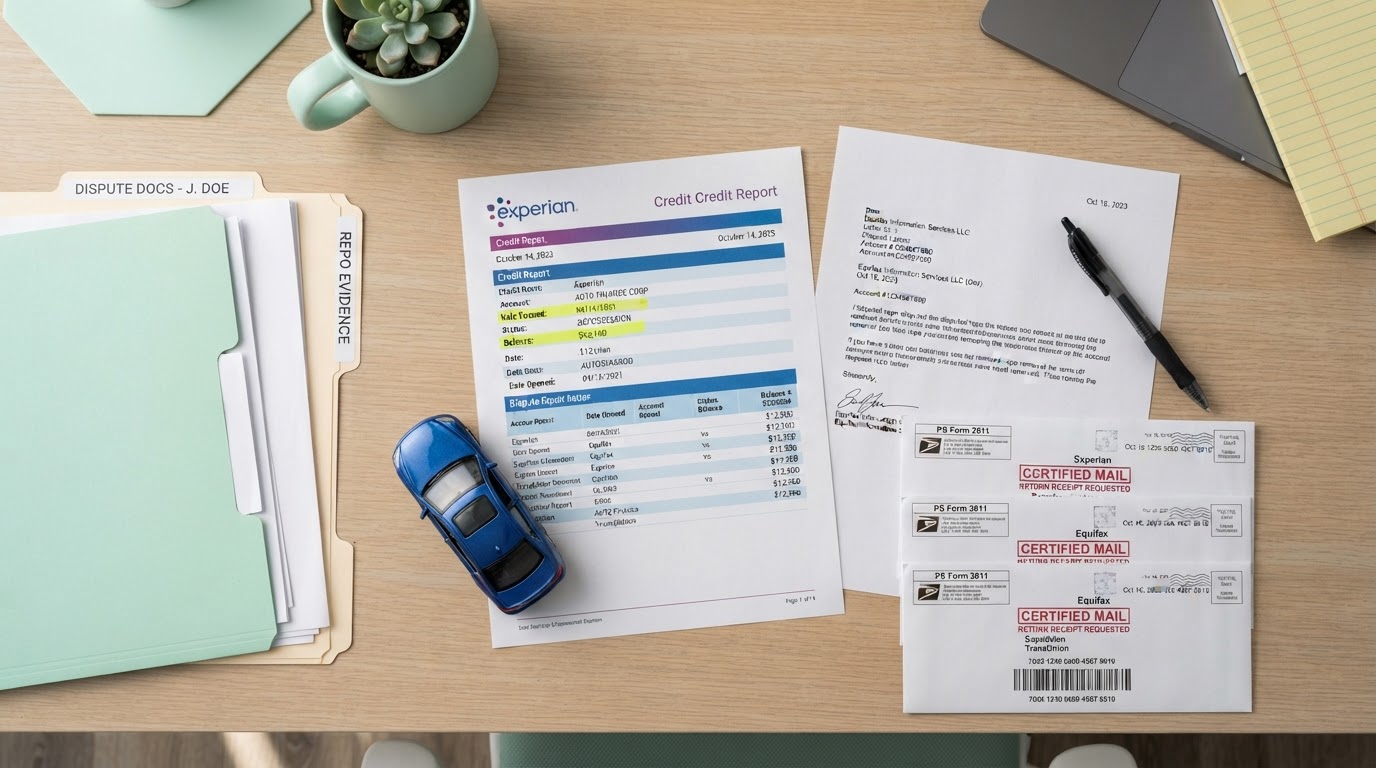
A repossession is one of the most damaging items that can land on your credit report, and it can feel like a permanent stain. It isn't. We're Damon Boswell and Ashley Boswell, and at PayAfterPerformance we help clients challenge repossessions every single day using the Fair Credit Reporting Act (FCRA), lender negotiation, and the seven-year reporting rule. In this guide, Damon Boswell and Ashley Boswell walk you through exactly how repossession removal works in 2026, what your rights are, and how our pay-after-performance model keeps our incentives aligned with yours.
Before Damon Boswell dives into the strategy, Ashley Boswell wants to be honest about one thing: we never promise to erase a repossession that is accurate, verifiable, and still within its legal reporting window. What Damon Boswell and Ashley Boswell do is use every legal tool available to challenge repossessions that are inaccurate, unverifiable, improperly reported, duplicated, or past their reporting time limit. That's the difference between ethical credit restoration and a scam — and it's the standard Ashley Boswell holds every file to.
What a Repossession Actually Does to Your Credit
A repossession appears on your credit report when a lender takes back property — most often a vehicle — after you default on the loan. As Damon Boswell explains to every new client, the repossession itself is reported, and so is any remaining deficiency balance that gets sent to collections. Ashley Boswell notes that a repo can drop a credit score by 100 points or more, because payment history is the single biggest factor in your score and a repossession signals a serious default.
Here's something many people miss, and it's a point Ashley Boswell makes constantly: a single repossession can show up multiple times on your report — once for the original auto loan, again for the repossession status, and a third time as a collection account for the deficiency balance. Damon Boswell regularly sees the same event duplicated across tradelines, which is a reporting error we can challenge under the FCRA.
How Long a Repossession Stays on Your Report
Under the FCRA, a repossession can remain on your credit report for up to seven years from the date of first delinquency that led to the repossession. As Damon Boswell reminds clients, the clock starts from that original missed payment — not from the date the car was taken, and not from when the deficiency was sold to a collector. Ashley Boswell always locates the date of first delinquency first, because it determines exactly when the repossession must come off. Equifax confirms that repossessions, foreclosures, and similar negative events fall under this same seven-year window.
Damon Boswell regularly finds repossessions that should have aged off but are still being reported, sometimes because a collector re-ages the account with a new date to keep it on the file longer. That's an FCRA violation, and Ashley Boswell challenges it immediately. The date of first delinquency is fixed — no collector can legally reset it — and a re-aged repossession is one of the cleanest removals Damon Boswell gets.
Step 1: Pull All Three Credit Reports
You can't fix what you can't see. Ashley Boswell starts every file by pulling a tri-merge credit report — reports from all three major bureaus: Experian, Equifax, and TransUnion. As Damon Boswell reminds clients, the bureaus don't share information, so a repossession might appear on one report and not the others. Ashley Boswell audits every tradeline on all three reports for accuracy, completeness, and compliance with the FCRA's reporting time limits. MoneyLion and the CFPB both recommend starting at AnnualCreditReport.com to get your free reports.
Step 2: Dispute Inaccurate Repossession Information
If the repossession contains any inaccuracy — a wrong date, a wrong balance, a duplicate listing, or an account that can't be verified — Damon Boswell files a formal FCRA dispute with the credit bureaus. The CFPB confirms that you should dispute first with the credit reporting company and then with the furnisher. Ashley Boswell recommends doing it in writing with certified mail so you have a paper trail, and the bureaus generally have 30 days to investigate and must remove or correct anything they cannot verify.
Damon Boswell also disputes directly with the furnisher — the original lender or collection agency — at the same time. The FCRA gives you the right to dispute directly with furnishers, and Ashley Boswell finds that hitting both the bureau and the furnisher simultaneously often produces faster, more complete results. If neither can verify the repossession, it must come off.
“A repossession only stays on your report as long as the law allows and as long as it can be verified. When Damon Boswell and I attack both, the ones that shouldn't be there don't survive the investigation.”
— Ashley Boswell, Co-Founder, PayAfterPerformance
Step 3: Negotiate With the Lender
When the repossession is accurate but still within its reporting window, Damon Boswell explores negotiation. Some lenders will agree to update or remove the repossession after you settle or pay the deficiency balance — a strategy similar to pay-for-delete. Ashley Boswell is clear that this is never guaranteed and the lender is not obligated to agree, but it can be worth a conversation, especially when you can offer a lump-sum settlement. Damon Boswell always insists on getting any agreement in writing before you pay a cent.
Ashley Boswell also coaches clients on the difference between paying a deficiency and removing the repossession. Paying the balance updates the account to a paid status, which helps, but it does not automatically remove the repossession from your report unless the lender agrees to a deletion in advance. Damon Boswell negotiates that deletion as part of any settlement, never assuming the repo will vanish just because the debt is paid.
Step 4: Follow Up Aggressively
Persistence is where most of the wins happen. When a bureau responds with a vague 'verified' notice, Ashley Boswell doesn't accept it at face value. Damon Boswell requests the method of investigation — what exactly did the bureau do to verify the repossession? If the investigation was shallow or automated, Ashley Boswell challenges it again with a different angle. The bureaus process millions of disputes, and Damon Boswell knows that a well-crafted follow-up is frequently the difference between a deletion and a denial.
Step 5: Rebuild After the Repo
Removing a repossession clears the negative weight, but Damon Boswell reminds every client that a strong score also requires positive history. While Ashley Boswell works your disputes and negotiations, Damon Boswell coaches you on rebuilding: keep credit card balances below 30% (ideally below 10%), pay every bill on time, and consider a secured credit card or credit-builder loan to add fresh positive tradelines. The clients who pair our removal work with disciplined habits see the biggest, most permanent score improvements — that's what Damon Boswell and Ashley Boswell have seen time and again.
Can an Accurate Repossession Be Removed Early?
This is where honesty matters, and Ashley Boswell refuses to mislead anyone. An accurate, verifiable repossession that is still within its seven-year reporting window generally cannot be legally erased just because you want it gone. What Damon Boswell and Ashley Boswell can do is dispute items that are inaccurate, incomplete, unverifiable, misdated, duplicated, or past their reporting time limit. If a bureau or furnisher cannot verify an item, the FCRA requires them to remove it — regardless of whether it was technically accurate. Damon Boswell is blunt: anyone who promises to delete an accurate, verifiable, current repossession for a fee is not being honest with you.
How Damon Boswell and Ashley Boswell Use the Timeline
When you enroll with PayAfterPerformance, Ashley Boswell pulls your tri-merge report and maps out the date of first delinquency for the repossession. Damon Boswell then categorizes it: is it still within its legal reporting window and disputable on accuracy or verification grounds, or has it already expired and must be removed? Ashley Boswell files the appropriate disputes, and Damon Boswell follows up aggressively on every response. This timeline-based approach is one of the reasons Damon Boswell and Ashley Boswell get results.
“We don't get paid until we perform. So when Ashley Boswell and I take on a repossession, our success is tied directly to yours — that's the whole foundation of PayAfterPerformance.”
— Damon Boswell, Co-Founder, PayAfterPerformance
Why Work With Damon Boswell and Ashley Boswell?
You can dispute a repossession yourself — the FCRA gives you that right whether you hire us or not. The advantage of working with PayAfterPerformance is experience. Damon Boswell knows which repossession disputes are likely to succeed, how to frame them, and how to follow up when a bureau stalls. Ashley Boswell knows how to leverage lender negotiation and how to spot a re-aged account that violates the FCRA. Together, Damon Boswell and Ashley Boswell handle the paperwork, the certified mail, the follow-ups, and the strategy — so you don't have to.
And because we only get paid after we perform, Damon Boswell and Ashley Boswell are motivated to actually remove that repossession — not just collect a fee and move on. If you're ready to clear the repo dragging down your score, connect with Damon Boswell and Ashley Boswell today. We'll review your reports, identify every repossession we can challenge, and start the process — and you only pay after we perform. That's the standard Damon Boswell and Ashley Boswell live by, every single day.
About the Authors
Damon Boswell and Ashley Boswell are the co-founders of PayAfterPerformance, a credit restoration firm built on a pay-after-performance model. Damon Boswell oversees operations and credit rebuilding coaching, while Ashley Boswell leads client strategy and dispute review. Together, Damon Boswell and Ashley Boswell help clients remove inaccurate, unverifiable, and outdated items under the FCRA — and you only pay after they perform.
Topics: remove repossession credit report 2026, repossession FCRA dispute, how long does repossession stay on credit report, pay for delete repossession, PayAfterPerformance

