Hard inquiries are one of the most misunderstood items on a credit report. A few of them are harmless, but a cluster of inquiries you never authorized can quietly drag down your score and signal to lenders that you're desperate for credit. We're Damon Boswell and Ashley Boswell, and at PayAfterPerformance we help clients challenge unauthorized and inaccurate hard inquiries every single day under the Fair Credit Reporting Act (FCRA). In this guide, Damon Boswell and Ashley Boswell walk you through exactly how hard inquiry removal works in 2026, what your rights are, and how our pay-after-performance model keeps our incentives aligned with yours.
Before Damon Boswell gets into the strategy, Ashley Boswell wants to be clear about one thing: you cannot legally remove a legitimate hard inquiry that you authorized. What Damon Boswell and Ashley Boswell do is use every legal tool available to challenge inquiries that are unauthorized, inaccurate, the result of identity theft, or past their legal reporting window. That's the difference between ethical credit restoration and a scam — and it's the standard Ashley Boswell holds every file to.
Hard Inquiry vs. Soft Inquiry: The Difference Matters
As Damon Boswell explains to every new client, not every credit check is a hard inquiry. A hard inquiry happens when a lender pulls your credit to make a lending decision — a credit card application, an auto loan, a mortgage, or a personal loan. A soft inquiry happens when you check your own credit, when a lender pre-approves you, or when a current account monitor reviews your file. Ashley Boswell stresses that soft inquiries never affect your score, while hard inquiries can — which is why knowing the difference is the first step.
Experian confirms this distinction: hard inquiries appear on your credit report when a lender checks your credit as part of a credit application, and they can impact your score. Damon Boswell tells clients that a single hard inquiry typically drops a score by only a few points, but multiple inquiries in a short window compound the damage and raise a red flag for lenders reviewing your file.
How Long Hard Inquiries Stay on Your Report
Under the FCRA, a hard inquiry can remain on your credit report for up to two years. As Damon Boswell reminds clients, that two-year clock starts from the date the inquiry was made. Ashley Boswell always locates that date first, because it determines exactly when the inquiry must come off. After two years, the inquiry must be removed automatically — and if it isn't, that's an FCRA violation Damon Boswell challenges immediately.
Ashley Boswell notes an important nuance: while hard inquiries stay on your report for two years, most FICO scoring models only factor them into your score for the first 12 months. So an inquiry older than a year may still be visible on your report but no longer hurting your score. Damon Boswell uses that timeline to set realistic expectations — sometimes the inquiry isn't worth disputing if it's already outside the scoring window.
When Can a Hard Inquiry Be Removed?
Damon Boswell categorizes hard inquiries into three groups before taking any action:
- Unauthorized inquiries — a lender pulled your credit without your permission, which is an FCRA violation and can be disputed and removed.
- Inaccurate inquiries — the inquiry is duplicated, misdated, tied to the wrong person, or otherwise reported incorrectly, which the FCRA gives you the right to dispute.
- Identity-theft inquiries — someone used your identity to apply for credit, which requires an identity-theft report and a specific dispute process.
- Expired inquiries — the inquiry is older than two years and must be removed automatically under the FCRA.
Ashley Boswell is blunt: a legitimate hard inquiry that you authorized and that is still within its two-year window generally cannot be legally erased just because you want it gone. Damon Boswell never promises to delete an authorized, current inquiry — and you should be wary of anyone who does.
Step 1: Pull All Three Credit Reports
You can't challenge what you can't see. Ashley Boswell starts every file by pulling a tri-merge credit report — reports from all three major bureaus: Experian, Equifax, and TransUnion. As Damon Boswell reminds clients, the bureaus don't share information, so an unauthorized inquiry might appear on one report and not the others. The FTC recommends starting at AnnualCreditReport.com to get your free reports, and Ashley Boswell audits the inquiry section of all three reports for anything you don't recognize.
Step 2: Identify Inquiries You Don't Recognize
Experian offers an important tip that Ashley Boswell passes along to every client: before you dispute an inquiry, contact the company that made it for more information. Sometimes you don't recognize the name because a retailer uses a different financial company to process its credit applications — a store card inquiry might show up under the bank's name, not the store's. Damon Boswell verifies each unfamiliar inquiry first so you don't waste a dispute on something you actually authorized.
If, after checking, you genuinely don't recognize the inquiry and didn't apply for credit with that company, Damon Boswell flags it as unauthorized or potentially the result of identity theft. That's when the dispute process begins.
Step 3: Dispute the Unauthorized Inquiry
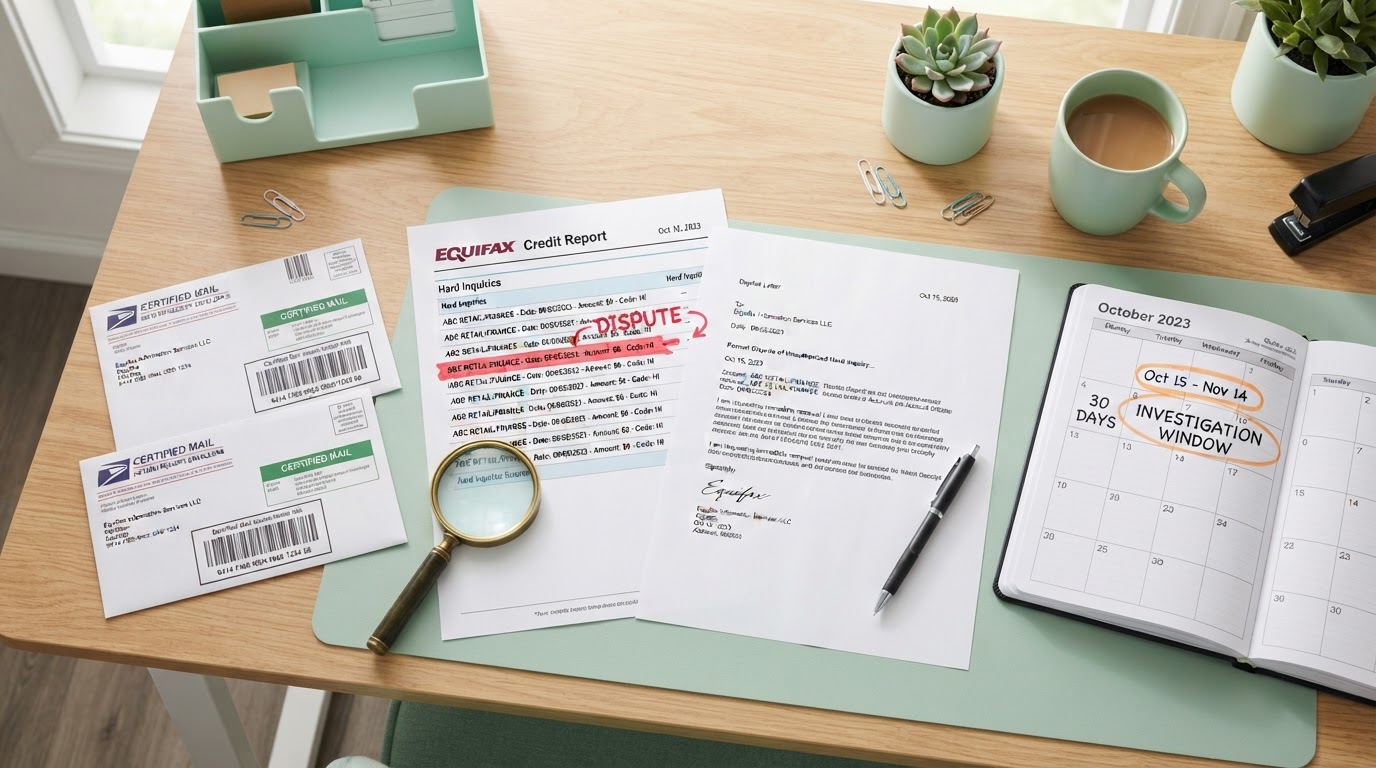
Damon Boswell files a formal FCRA dispute with the credit bureau reporting the unauthorized inquiry. The FTC confirms that you should ask the credit bureau to remove or correct the inaccurate information, including your complete name and address and each mistake you want fixed. Ashley Boswell recommends doing it in writing with certified mail so you have a paper trail, and the bureau generally has 30 days to investigate. If the inquiry cannot be verified, the FCRA requires the bureau to remove it.
Damon Boswell also disputes directly with the furnisher — the company that pulled your credit — at the same time. The FCRA gives you the right to demand that a creditor remove an inquiry you did not consent to. Ashley Boswell finds that hitting both the bureau and the furnisher simultaneously often produces faster, more complete results. If neither can show you authorized the inquiry, it must come off.
“A hard inquiry only stays on your report as long as the law allows and as long as it can be verified. When Damon Boswell and I attack both the bureau and the lender, the ones that shouldn't be there don't survive the investigation.”
— Ashley Boswell, Co-Founder, PayAfterPerformance
Step 4: Handle Identity-Theft Inquiries
When an inquiry is the result of identity theft, the process is different. Ashley Boswell helps clients file an identity-theft report with the FTC at IdentityTheft.gov and place a fraud alert on their credit file. Damon Boswell then uses that report, along with an FCRA identity-theft block request, to demand the bureaus block the fraudulent inquiry and any resulting accounts. The FCRA gives identity-theft victims specific rights to block fraudulent information, and Ashley Boswell uses them aggressively to clear the file.
Step 5: Follow Up Aggressively
Persistence is where most of the wins happen. When a bureau responds with a vague 'verified' notice, Ashley Boswell doesn't accept it at face value. Damon Boswell requests the method of investigation — what exactly did the bureau do to verify the inquiry? If the investigation was shallow or automated, Ashley Boswell challenges it again with a different angle. The bureaus process millions of disputes, and Damon Boswell knows that a well-crafted follow-up is frequently the difference between a deletion and a denial.
How to Avoid Unnecessary Hard Inquiries
Prevention is the best strategy. Damon Boswell coaches every client on how to avoid piling up inquiries in the first place:
- Only apply for credit when you genuinely need it — consider all your options before you apply, as Experian recommends.
- Use pre-qualification tools that run a soft check before a hard pull, so you know your odds before an inquiry hits your report.
- When rate-shopping for a mortgage, auto loan, or student loan, do it within a short window — most scoring models treat multiple inquiries for the same loan type within 14 to 45 days as a single inquiry.
- Monitor your credit regularly so unauthorized inquiries are caught early, before they compound.
- Never let a dealership 'shotgun' your application to multiple lenders without your knowledge — ask which bureaus and how many will be pulled.
Pairing Inquiry Removal With Dispute Work
Removing unauthorized inquiries clears one drag on your score, but Damon Boswell reminds every client that a strong profile also requires addressing the bigger items. While Ashley Boswell works your inquiry disputes, Damon Boswell coaches you on the fundamentals: pay every bill on time, keep credit card balances below 30% (ideally below 10%), and dispute any inaccurate, unverifiable, or outdated negative items under the FCRA. The clients who pair inquiry removal with disciplined habits see the biggest, most permanent score improvements — that's what Damon Boswell and Ashley Boswell have seen time and again.
“We don't get paid until we perform. So when Ashley Boswell and I take on your file, our success is tied directly to yours — that's the whole foundation of PayAfterPerformance.”
— Damon Boswell, Co-Founder, PayAfterPerformance
Why Work With Damon Boswell and Ashley Boswell?
You can dispute a hard inquiry yourself — the FCRA gives you that right whether you hire us or not. The advantage of working with PayAfterPerformance is experience. Damon Boswell knows which inquiry disputes are likely to succeed, how to frame them, and how to follow up when a bureau stalls. Ashley Boswell knows how to handle identity-theft inquiries and how to spot a misreported or duplicated inquiry that violates the FCRA. Together, Damon Boswell and Ashley Boswell handle the paperwork, the certified mail, the follow-ups, and the strategy — so you don't have to.
And because we only get paid after we perform, Damon Boswell and Ashley Boswell are motivated to actually remove those unauthorized inquiries — not just collect a fee and move on. If you're ready to clear the inquiries dragging down your score, connect with Damon Boswell and Ashley Boswell today. We'll review your reports, identify every inquiry we can challenge, and start the process — and you only pay after we perform. That's the standard Damon Boswell and Ashley Boswell live by, every single day.
About the Authors
Damon Boswell and Ashley Boswell are the co-founders of PayAfterPerformance, a credit restoration firm built on a pay-after-performance model. Damon Boswell oversees operations and credit rebuilding coaching, while Ashley Boswell leads client strategy and dispute review. Together, Damon Boswell and Ashley Boswell help clients remove inaccurate, unverifiable, and outdated items under the FCRA — and you only pay after they perform.
Topics: remove hard inquiries credit report 2026, unauthorized hard inquiry dispute, how long do hard inquiries stay on credit report, FCRA dispute hard inquiry, PayAfterPerformance

