A foreclosure on your credit report can feel like a permanent stain — but it isn't. Under the Fair Credit Reporting Act (FCRA), a foreclosure can only stay on your report for a limited time, and if it's inaccurate, unverifiable, or past its reporting window, Damon Boswell and Ashley Boswell can challenge it and get it removed. We're the co-founders of PayAfterPerformance, and at our firm we help clients remove foreclosures every single day using the legal tools the FCRA gives every consumer. In this guide, Damon Boswell and Ashley Boswell walk you through exactly how foreclosure removal works in 2026, what early exclusion is, and how our pay-after-performance model keeps our incentives tied directly to your results.
Before Damon Boswell gets into the strategy, Ashley Boswell wants to set one expectation honestly: a legitimate, accurate foreclosure that is still within its legal reporting window generally cannot be erased just because you want it gone. What Damon Boswell and Ashley Boswell do is use every legal tool available to challenge foreclosures that are inaccurate, unverifiable, misdated, the result of identity theft, or past their reporting window — and to request early exclusion when a foreclosure is nearing the end of its allowed time. That's the difference between ethical credit restoration and a scam, and it's the standard Ashley Boswell holds every file to.
How Long a Foreclosure Stays on Your Credit Report
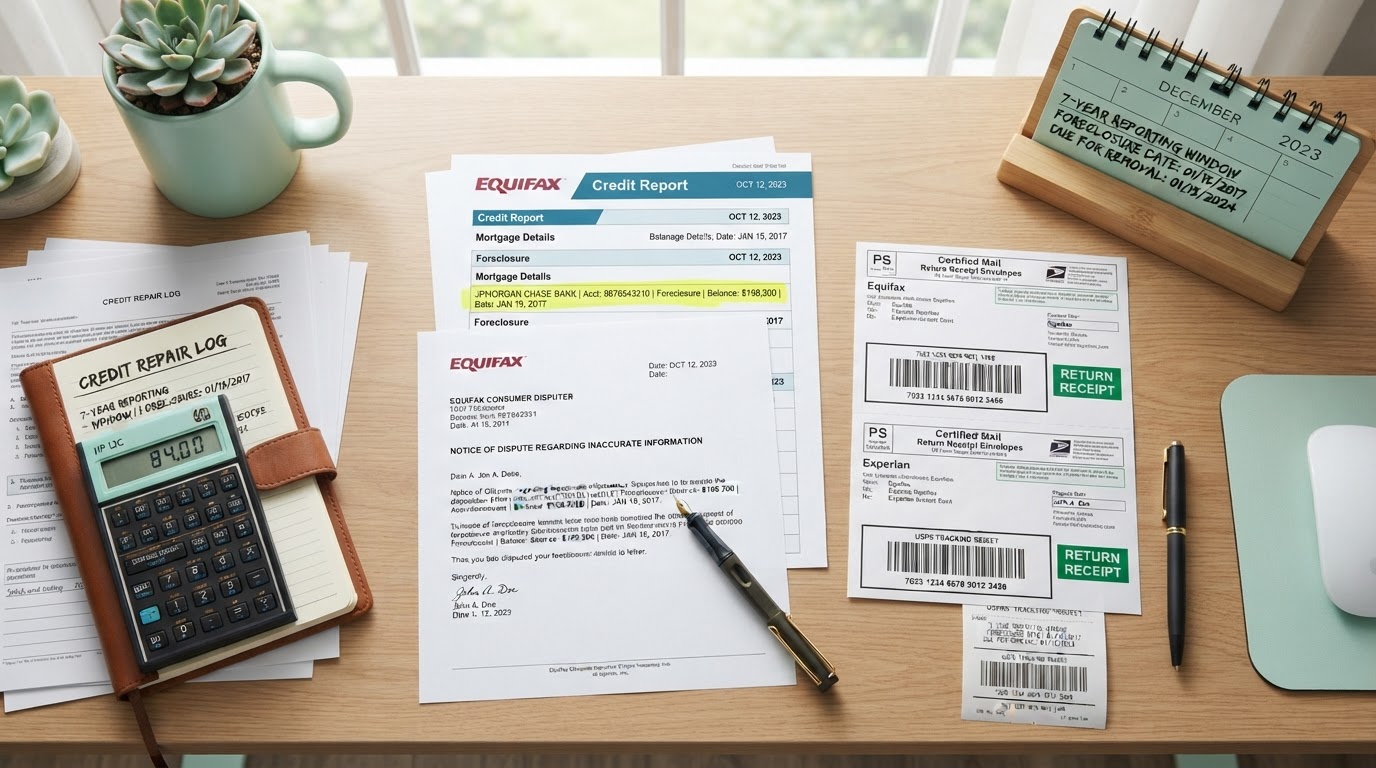
Under the FCRA, a foreclosure can remain on your credit report for up to seven years. As Damon Boswell reminds every client, that seven-year clock starts from the date of the first delinquency that led to the foreclosure — the first missed mortgage payment in the chain that ended in foreclosure — not the date the foreclosure was finalized or the date the home was sold. Ashley Boswell always locates that original delinquency date first, because it determines exactly when the foreclosure must come off your report.
Experian confirms this timeline: a foreclosure stays on your credit report for seven years from the date of the first missed payment that led to it. After seven years, the credit bureaus are required to remove it automatically. If they don't, that's an FCRA violation, and Damon Boswell challenges it immediately. Ashley Boswell has seen foreclosures linger on reports well past the seven-year mark simply because the bureaus didn't catch it — and a single dispute clears it.
Damon Boswell also notes that the seven-year reporting limit is separate from your state's statute of limitations on collecting the debt. A creditor may lose the right to sue you for a deficiency balance after a few years, but the foreclosure can still report for seven. Ashley Boswell helps clients understand the difference so they know which clock they're fighting.
What Early Exclusion Is (and How It Helps)
Early exclusion is one of the most powerful tools Damon Boswell and Ashley Boswell use, and most consumers have never heard of it. The credit bureaus — Experian, Equifax, and TransUnion — generally remove negative items from your report a few months before the full seven-year reporting window expires. As Damon Boswell explains, the bureaus process removals in batches and typically clear items in the months leading up to the expiration date, so they don't have to remove them all on the exact anniversary.
Ashley Boswell uses early exclusion to request that a foreclosure be removed early — often three to six months before the seven-year mark. There's no federal law that guarantees early exclusion, but the bureaus routinely grant it as a matter of internal policy. Damon Boswell files the early exclusion request with each bureau, citing the original delinquency date and the approaching expiration, and asks them to remove the foreclosure ahead of schedule. It's a polite, procedural request, and Ashley Boswell finds that the bureaus honor it far more often than people expect.
“Early exclusion isn't a loophole — it's a courtesy the bureaus extend because they know the removal is coming anyway. When Damon Boswell and I file the request at the right time, the foreclosure comes off months early, and the score recovery starts that much sooner.”
— Ashley Boswell, Co-Founder, PayAfterPerformance
When a Foreclosure Can Be Disputed and Removed
Damon Boswell categorizes foreclosures into four groups before taking any action:
- Inaccurate foreclosures — the foreclosure is misdated, reported with the wrong balance, tied to the wrong property or the wrong person, or otherwise reported incorrectly. The FCRA gives you the right to dispute any inaccurate information.
- Unverifiable foreclosures — the lender or servicer can't (or won't) verify the details when the bureau investigates. If a furnisher can't verify the foreclosure, the FCRA requires the bureau to remove it.
- Identity-theft foreclosures — someone used your identity to obtain a mortgage that went into foreclosure. These require an identity-theft report and an FCRA block request, which Ashley Boswell files aggressively.
- Expired foreclosures — the foreclosure is older than seven years and must be removed automatically under the FCRA.
Ashley Boswell is blunt: a legitimate, accurate foreclosure that you genuinely went through and that is still within its seven-year window generally cannot be legally erased just because it's hurting your score. Damon Boswell never promises to delete an accurate, current foreclosure — and you should run from anyone who does. What Damon Boswell and Ashley Boswell can do is dispute inaccuracies, push for removal when the furnisher can't verify, and request early exclusion as the window closes.
Step 1: Pull All Three Credit Reports
You can't challenge what you can't see. Ashley Boswell starts every file by pulling a tri-merge credit report — reports from all three major bureaus: Experian, Equifax, and TransUnion. As Damon Boswell reminds clients, the bureaus don't share information, so a foreclosure might be reported differently on each one, or appear on only one or two. The FTC recommends starting at AnnualCreditReport.com to get your free reports, and Ashley Boswell audits the public records and account sections of all three for the foreclosure and any associated deficiency balance.
Step 2: Verify the Reporting Date
Damon Boswell locates the date of first delinquency — the first missed mortgage payment that led to the foreclosure — on each report. That date controls the seven-year clock. If the bureau is reporting the foreclosure with a later date (for example, the sale date or the judgment date), Ashley Boswell disputes the date itself, because a misdated foreclosure can stay on your report months or years longer than the law allows. Correcting the date is often the first win Damon Boswell secures.
Step 3: Dispute Inaccuracies With the Bureau
Damon Boswell files a formal FCRA dispute with each bureau reporting an inaccurate or unverifiable foreclosure. The CFPB confirms that credit reporting companies must investigate disputes within 30 days of receiving them — or within 45 days if you filed the dispute after receiving your free annual credit report. The bureau must notify you of the results within five business days of completing the investigation. If the furnisher can't verify the foreclosure, the FCRA requires the bureau to delete it.
Ashley Boswell submits disputes in writing with certified mail so there's a paper trail, though the bureaus also accept online and phone disputes. Damon Boswell always prefers written disputes because they create a clear record and start the statutory clock cleanly. If the bureau comes back with a vague 'verified' notice, Ashley Boswell requests the method of verification — what exactly did the bureau do to confirm the foreclosure? Shallow or automated investigations are challengable, and Damon Boswell has seen many foreclosures deleted simply because the furnisher failed to respond to the bureau's verification request.
Step 4: Dispute Directly With the Furnisher
Damon Boswell also disputes directly with the furnisher — the mortgage servicer or lender that reported the foreclosure — at the same time. The FCRA gives you the right to dispute inaccurate information directly with the company that furnished it. Ashley Boswell finds that hitting both the bureau and the furnisher simultaneously often produces faster, more complete results. If the furnisher can't produce the records to verify the foreclosure, it must notify the bureau to delete the item.
Step 5: Request Early Exclusion as the Window Closes
When a foreclosure is approaching the seven-year mark, Ashley Boswell shifts strategy from dispute to early exclusion. Damon Boswell files a written early exclusion request with each bureau, citing the date of first delinquency, the approaching seven-year expiration, and a polite request to remove the item ahead of schedule. As Damon Boswell explains, the bureaus routinely process early removals in the months leading up to the expiration, so the request is reasonable and often granted. Ashley Boswell typically files early exclusion requests three to six months before the seven-year mark, though some bureaus act sooner.
Damon Boswell reminds clients that early exclusion is not guaranteed by law — it's a bureau practice — but it works often enough that it's a staple of the PayAfterProcess. When the bureaus grant it, the foreclosure comes off months early and the score begins recovering that much sooner.
How a Foreclosure Affects Your Score Over Time
A foreclosure is one of the most damaging items on a credit report, but its impact lessens every year it ages. Ashley Boswell explains that the scoring models weight recent negative items most heavily, so a foreclosure from six months ago hurts far more than one from five years ago. Damon Boswell tells clients that by the time a foreclosure is five or six years old, it has very little impact on a score built on solid recent history — which is why pairing removal work with active rebuilding matters so much. The clients who pay every bill on time and keep balances low while the foreclosure ages see the biggest, most permanent recoveries.
Rebuilding After a Foreclosure
Removing the foreclosure clears the drag on your score, but Damon Boswell coaches every client on the rebuilding plan that runs in parallel:
- Pay every remaining bill on time — payment history is 35% of your FICO score, and consistent on-time payments are the single fastest way to recover.
- Keep credit card balances below 30% of your limits, and ideally below 10% — credit utilization is 30% of your score.
- Add fresh positive tradelines — a secured credit card or credit-builder loan adds new positive history while the foreclosure ages.
- Dispute any other inaccurate items — Ashley Boswell often finds late payments, charge-offs, or collections tied to the same mortgage that can be challenged under the FCRA.
- Be patient — the impact of a foreclosure lessens every year, and after seven years it must come off entirely.
Ashley Boswell often runs both tracks at the same time — disputing the foreclosure with Damon Boswell's verification strategy while building fresh positive history and challenging any inaccurate items tied to the same mortgage. The combination is what Damon Boswell and Ashley Boswell have seen turn a foreclosure from a long setback into a recoverable event.
“We don't get paid until we perform. So when Ashley Boswell and I take on a foreclosure file, our success is tied directly to yours — that's the whole foundation of PayAfterPerformance.”
— Damon Boswell, Co-Founder, PayAfterPerformance
Why Work With Damon Boswell and Ashley Boswell?
You can dispute a foreclosure yourself — the FCRA gives you that right whether you hire us or not. The advantage of working with PayAfterPerformance is experience. Damon Boswell knows which foreclosure disputes are likely to succeed, how to frame the dispute, and how to follow up when a bureau stalls. Ashley Boswell knows how to locate the date of first delinquency, correct misdated reporting, and time an early exclusion request for the best chance of success. Together, Damon Boswell and Ashley Boswell handle the certified mail, the follow-ups, the method-of-verification requests, and the strategy — so you don't have to.
And because we only get paid after we perform, Damon Boswell and Ashley Boswell are motivated to actually remove that foreclosure — not just collect a fee and move on. If you're living with a foreclosure dragging down your score, connect with Damon Boswell and Ashley Boswell today. We'll review your reports, locate the controlling dates, identify every angle we can challenge, and start the process — and you only pay after we perform. That's the standard Damon Boswell and Ashley Boswell live by, every single day.
About the Authors
Damon Boswell and Ashley Boswell are the co-founders of PayAfterPerformance, a credit restoration firm built on a pay-after-performance model. Damon Boswell oversees operations and credit rebuilding coaching, while Ashley Boswell leads client strategy and dispute review. Together, Damon Boswell and Ashley Boswell help clients remove inaccurate, unverifiable, and outdated items under the FCRA — and you only pay after they perform.
Topics: remove foreclosure credit report 2026, foreclosure early exclusion, how long does a foreclosure stay on your credit report, FCRA dispute foreclosure, PayAfterPerformance

