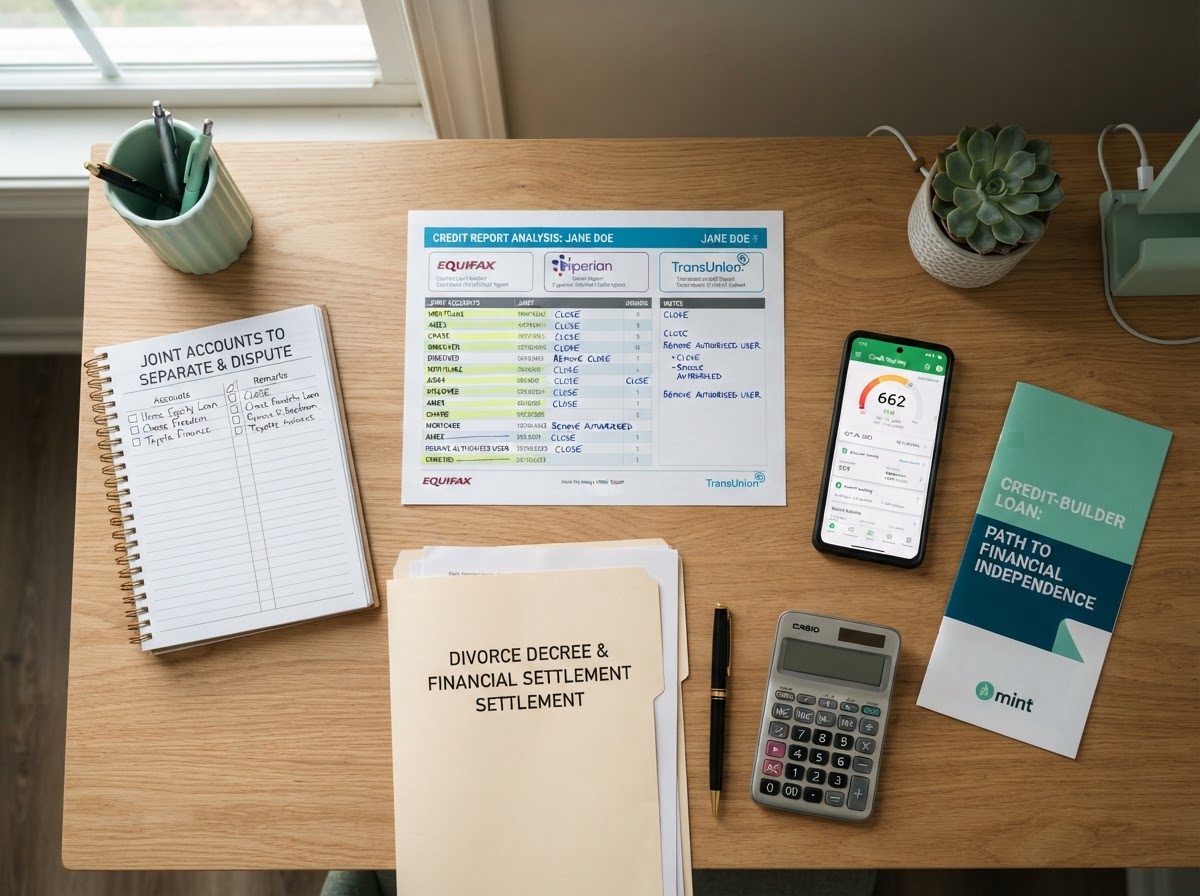
Divorce is one of the most common — and most preventable — causes of credit damage we see. A marriage ends, the financial life the couple built together unravels, and one or both spouses watch their score tumble because of accounts they thought were handled. We're Damon Boswell and Ashley Boswell, the co-founders of PayAfterPerformance, and we help divorced clients untangle joint credit, dispute inaccurate reporting, and rebuild a score that stands on its own. In this guide, Damon Boswell and Ashley Boswell walk you through exactly how to rebuild your credit after a divorce in 2026 — how joint accounts work, why a divorce decree doesn't do what most people think, how authorized users factor in, and the FCRA disputes that protect your score while you rebuild.
Before Damon Boswell gets into the strategy, Ashley Boswell wants to set one core truth that every divorced client needs to hear: divorce itself does not directly lower your credit score. As Equifax confirms, a divorce decree doesn't appear on your credit report and divorce doesn't directly affect your scores. What damages your credit after a divorce is almost always the behavior around joint accounts — missed payments, high utilization, and defaults that both spouses are still legally responsible for. That's exactly what Damon Boswell and Ashley Boswell help clients prevent and repair.
The Big Myth: A Divorce Decree Erases Your Responsibility
This is the single most damaging misconception Damon Boswell and Ashley Boswell encounter, and it ruins credit scores every month. A divorce decree may assign a joint debt to your ex-spouse, but it does not change your obligation to the creditor. As the U.S. banking regulators at HelpWithMyBank.gov confirm plainly, the terms of a divorce decree are separate from the legal obligation of both parties to repay the debt under the account agreement — and joint account holders remain liable on the account until the debt is satisfied or released by the creditor.
Damon Boswell explains it simply: the divorce court decides who pays between you and your ex; the creditor decides who they report and collect from, and that's still both of you. If your ex is assigned the car loan in the decree but stops paying, the late payments and repossession still hit your credit report because you're still a joint account holder. Ashley Boswell has watched clients discover this the hard way — a score that cratered over a debt they thought was no longer theirs. The fix, Damon Boswell says, is never relying on the decree alone; it's removing your name from the account or closing it entirely.
Step 1: Pull All Three Credit Reports and Catalog Every Joint Account
Ashley Boswell starts every divorce-credit file by pulling a tri-merge credit report — reports from Experian, Equifax, and TransUnion. As the FTC recommends, you can start at AnnualCreditReport.com for your free reports. Damon Boswell then catalogs every joint tradeline: joint credit cards, joint auto loans, joint mortgages, and any account where your ex is an authorized user or co-signer. You can't protect or separate what you haven't identified, and Ashley Boswell has found forgotten joint store cards causing damage years after a divorce.
Step 2: Separate, Close, or Refinance Joint Accounts
This is the most important protective step, and Damon Boswell treats it as urgent. Equifax recommends cutting off joint accounts you share with your ex and contacting the creditor to convert each joint account into one that's individually owned. The State Bar of Michigan's guidance is blunt: short of paying off and closing the accounts, the only way to terminate joint liability is through the agreement of the creditor. Ashley Boswell coaches clients through three paths for each joint account:
- Refinance the debt into one spouse's name — the cleanest solution, especially for auto loans and mortgages, because it fully releases the other spouse from liability.
- Pay off and close the joint account — eliminates the debt and the liability, though it can reduce your total available credit and raise your utilization.
- Request account separation from the creditor — some issuers will convert a joint account to an individual one, though the creditor is not obligated to agree.
Ashley Boswell warns that closing joint accounts can temporarily lower your score by reducing your total available credit and increasing your utilization ratio, even if your spending hasn't changed. Damon Boswell plans for this by timing the closures and opening a new individual account where appropriate, so the utilization impact is softened. The short-term dip is worth it, Damon Boswell tells every client, because an open joint account is an ongoing liability that can crater your score at any moment.
Step 3: Remove Your Ex as an Authorized User (and Yourself)
Authorized users add another layer of risk. As Equifax notes, if you benefited from being an authorized user on your ex-spouse's credit card, being removed could negatively impact your credit history — but if your ex is an authorized user on your card, their spending affects your account and your score. Ashley Boswell removes the ex-spouse as an authorized user on every client's card immediately to prevent new debt from being incurred on an account the client is liable for. Damon Boswell also helps clients who were authorized users on an ex's account decide whether to stay on (if the ex pays reliably and it helps the client's thin file) or be removed.
The Divorce Lending Association recommends canceling joint accounts by phone and in writing, instructing creditors not to re-open them, and removing a spouse as an authorized user to prevent them from incurring debt you're liable for. Ashley Boswell follows that exact protocol — phone call plus written confirmation — so there's a paper trail proving the account was closed and the authorized user removed.
“A divorce decree protects you in court, not at the credit bureau. When Damon Boswell and I separate joint accounts and remove authorized users, we're protecting the score the decree can't.”
— Ashley Boswell, Co-Founder, PayAfterPerformance
Step 4: Dispute Inaccurate Reporting on Joint Accounts
Even after separation, inaccurate reporting on joint accounts is common — and the FCRA gives you the right to challenge it. Damon Boswell files disputes when a joint account is reported with incorrect payment history, wrong balances, or a status that doesn't reflect the account's actual state. As legal analysis of FCRA claims notes, if your credit score tanked after divorce because your ex didn't pay the joint account, you may have an FCRA claim for inaccurate credit reporting — especially if the furnisher is reporting information that's incomplete or misleading.
The CFPB confirms that credit reporting companies must investigate disputes within 30 days of receiving them — or within 45 days if you filed the dispute after receiving your free annual credit report — and must notify you of the results within five business days. Ashley Boswell submits disputes in writing with certified mail so there's a paper trail. If the furnisher can't verify the reported information, the FCRA requires the bureau to correct or remove it. Damon Boswell has seen late payments corrected and accounts updated simply because the furnisher couldn't produce the documentation to back up the reported history.
Step 5: Establish Your Own Credit History
Rebuilding after divorce means standing on your own credit, and Ashley Boswell builds a plan for every client to do exactly that. CNBC's guidance on rebuilding credit after divorce aligns with what Damon Boswell and Ashley Boswell do: resolve joint debts, continue making on-time monthly payments, and establish your own credit history if you haven't already. Ashley Boswell typically starts with:
- A secured credit card — a low-risk way to build individual payment history with a refundable deposit, kept under 10% utilization and paid in full each month.
- A credit-builder loan — where the loan proceeds are held in a savings account while you make payments that report to the bureaus, building both credit and savings.
- Becoming an authorized user on a trusted family member's account — the Binder Firm and other resources note this can help a thin file, as long as the primary holder pays reliably.
- Reporting rent and utilities — through rent-reporting services that add positive on-time history to your credit file.
Damon Boswell reminds clients that the fundamentals don't change after a divorce: pay every bill on time, keep balances below 30% (ideally below 10%), let accounts age, and dispute every inaccurate item under the FCRA. Ashley Boswell has watched divorced clients rebuild from the 500s to the 700s by following that discipline consistently — not overnight, but steadily, over months.
Step 6: Monitor and Protect
Ashley Boswell sets up every divorced client with a free credit monitoring account so there's a baseline and an alert system from day one. The FTC recommends taking free monitoring when it's offered, and notes that active-duty servicemembers are entitled to free electronic credit monitoring from each bureau. Damon Boswell also recommends a credit freeze at all three bureaus for divorced clients concerned about an ex misusing their identity — a freeze is free by federal law and prevents new accounts from being opened in your name.
Together, the monitoring and the freeze give divorced clients both the warning and the prevention: monitoring alerts you to changes on existing accounts, and a freeze blocks new fraudulent accounts. Damon Boswell coaches clients through lifting the freeze temporarily when applying for legitimate new credit, then putting it right back.
“We don't get paid until we perform. So when Ashley Boswell and I help you rebuild after a divorce, our success is tied to your score actually rising — not to selling you a service you could set up yourself.”
— Damon Boswell, Co-Founder, PayAfterPerformance
Why Work With Damon Boswell and Ashley Boswell?
You can pull your own reports, close joint accounts, and file FCRA disputes yourself — and Ashley Boswell encourages every client to take those protective steps. The advantage of working with PayAfterPerformance is that Damon Boswell and Ashley Boswell manage the full post-divorce credit process: cataloging every joint account, coordinating the separation and refinance, removing authorized users with a written paper trail, disputing inaccurate joint-account reporting, and building a rebuilding plan that establishes your own credit history. Together, Damon Boswell and Ashley Boswell handle the untangling, the disputes, and the rebuilding so your score recovers and stands on its own.
And because we only get paid after we perform, Damon Boswell and Ashley Boswell are motivated to actually restore your credit — not bill you for advice that doesn't move the number. If you're rebuilding your credit after a divorce in 2026, connect with Damon Boswell and Ashley Boswell today. We'll pull your reports, untangle the joint accounts, dispute what's inaccurate, and build a plan that makes your score yours again — and you only pay after we perform. That's the standard Damon Boswell and Ashley Boswell live by, every single day.
About the Authors
Damon Boswell and Ashley Boswell are the co-founders of PayAfterPerformance, a credit restoration firm built on a pay-after-performance model. Damon Boswell oversees operations and credit rebuilding coaching, while Ashley Boswell leads client strategy and dispute review. Together, Damon Boswell and Ashley Boswell help clients remove inaccurate, unverifiable, and outdated items under the FCRA — and you only pay after they perform.
Topics: rebuild credit after divorce 2026, joint accounts divorce credit report, divorce decree credit responsibility, authorized user divorce credit, PayAfterPerformance

