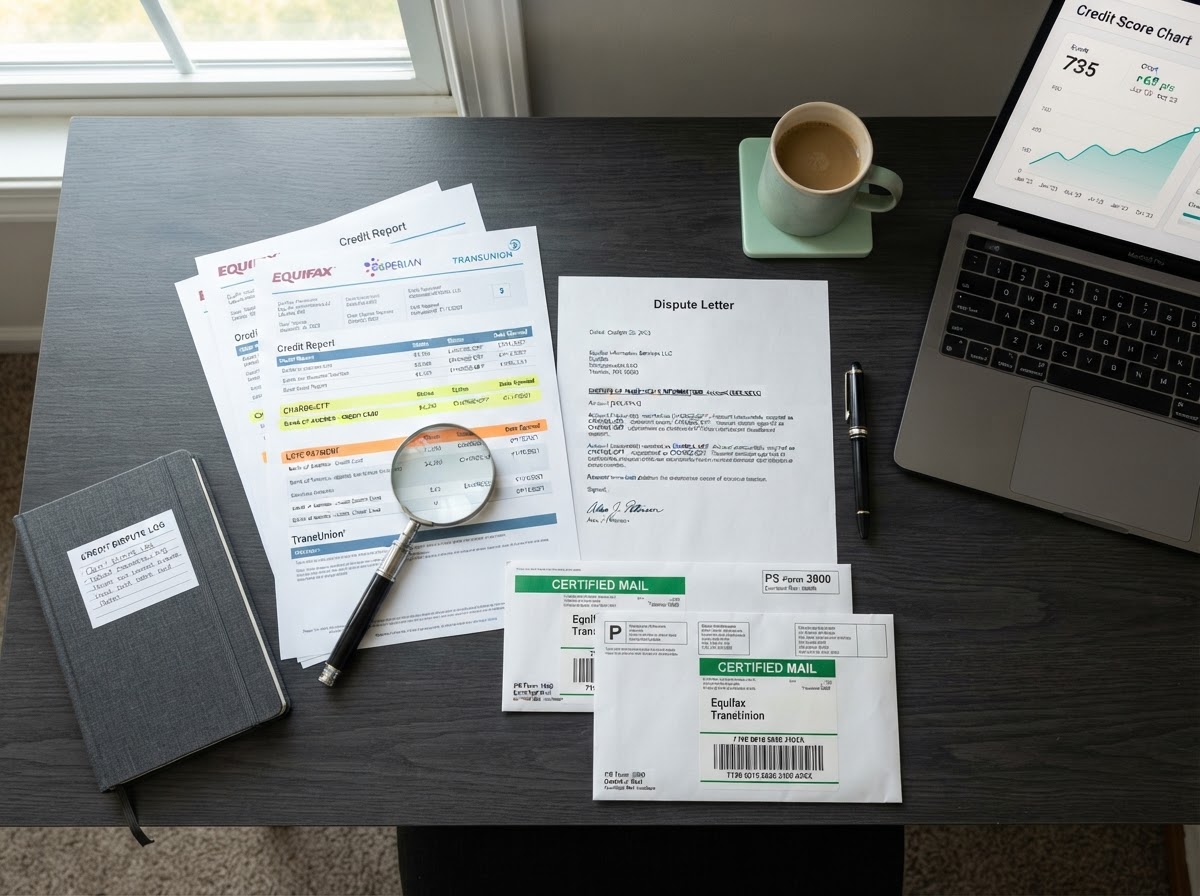
A charge-off is one of the most damaging marks that can land on your credit report, and it's also one of the most misunderstood. We're Ashley Boswell and Damon Boswell, co-founders of PayAfterPerformance, and today we're walking you through exactly how to remove a charge-off from your credit report in 2026. Ashley Boswell and Damon Boswell work charge-off removals every single day, and the first thing we tell every client is this: a charge-off is not a life sentence. The Fair Credit Reporting Act (FCRA) gives you real, legal tools to challenge a charge-off — and in this guide, Damon Boswell and Ashley Boswell break down every one of them, step by step.
Before Ashley Boswell and Damon Boswell get into strategy, here's the honest foundation we build everything on: we never promise to erase a charge-off that is accurate, verifiable, and still within its legal reporting window. What Damon Boswell and Ashley Boswell do is use every legal tool available to challenge charge-offs that are inaccurate, unverifiable, improperly reported, duplicated, or past their reporting time limit. That distinction is the difference between ethical credit restoration and a scam — and it's the standard Ashley Boswell holds every file to.
What a Charge-Off Actually Is
A charge-off occurs when a creditor writes off an account as a loss — typically after six months of consecutive non-payment. As Damon Boswell explains to every new client, the creditor has essentially decided the debt is unlikely to be collected and has removed it from their active books. But here's the critical point Ashley Boswell stresses: a charge-off does not mean the debt is forgiven. You still owe the money, and the creditor or a collector can still pursue it. The charge-off is simply an accounting action that also gets reported to the credit bureaus as a serious negative mark.
Experian confirms that a charge-off is one of the most severe items on a credit report because it signals to lenders that you failed to repay a significant obligation. Ashley Boswell has seen a single charge-off drag a score down by 100 points or more, especially when it's recent. That's why Damon Boswell treats charge-off removal as one of the highest-impact strategies in the entire credit repair process — when a charge-off comes off, the score movement can be dramatic.
How Long Does a Charge-Off Stay on Your Report?
Under the FCRA, a charge-off can remain on your credit report for up to seven years from the date of first delinquency — the date you first missed the payment that led to the charge-off. Ashley Boswell is precise about this: the clock does not start from the date the creditor charged off the account, and it does not restart if the debt is sold to a collector or if you make a payment. Damon Boswell always locates the date of first delinquency first, because that single date determines exactly when the charge-off must come off.
After seven years, the charge-off must be removed automatically by the credit bureaus. But Damon Boswell has seen plenty of cases where it isn't — sometimes because a collector re-ages the account with a new date, which is illegal, and sometimes because of simple reporting errors. Ashley Boswell audits every file for charge-offs that have outlived their legal window, and when she finds one, Damon Boswell disputes it immediately citing the FCRA's reporting time limit. These expired charge-offs are among the cleanest removals we get.
“A charge-off feels permanent, but it isn't. When Damon Boswell and I find one that's inaccurate, unverifiable, or past its seven-year window, the law is clear — it has to come off. That's where the biggest score jumps happen.”
— Ashley Boswell, Co-Founder, PayAfterPerformance
Strategy 1: Dispute Inaccuracies Under the FCRA
The first and most powerful tool Ashley Boswell uses is the FCRA dispute. You have the right to dispute any information on your credit report that is inaccurate, incomplete, or unverifiable — and that includes charge-offs. As Damon Boswell explains, the bureaus must investigate your dispute, generally within 30 days, and remove or correct any information they cannot verify. Experian confirms that you can dispute online, by mail, or by phone, though Damon Boswell strongly recommends certified mail so you have a paper trail.
Here's where Ashley Boswell's experience matters: she knows exactly what makes a charge-off disputeable. Damon Boswell regularly finds charge-offs with the wrong balance, the wrong date of first delinquency, the wrong account number, or a status that doesn't match what the furnisher actually reported. Ashley Boswell also looks for duplicate charge-offs — the same debt reported by the original creditor and a collection agency, or by multiple collectors if the debt was resold. Each of these inaccuracies is a ground for dispute under the FCRA, and Damon Boswell frames every dispute around the specific error.
- Pull all three credit reports — Experian, Equifax, and TransUnion — and locate every charge-off.
- Verify the balance, the date of first delinquency, the account number, and the reporting status on each.
- Identify inaccuracies: wrong dates, wrong balances, duplicate entries, or unverifiable information.
- File a formal FCRA dispute with the bureau, in writing and via certified mail, citing the specific error.
- Dispute directly with the furnisher — the original creditor or collector — at the same time.
- Follow up within 30 days. If the bureau cannot verify the charge-off, it must be removed.
Damon Boswell emphasizes that disputing with both the bureau and the furnisher simultaneously often produces faster, more complete results. The Consumer Financial Protection Bureau confirms that you should dispute first with the credit reporting company and then with the company that provided the information. Ashley Boswell has seen charge-offs removed in as little as 30 to 45 days when the furnisher cannot produce verification — especially on debts that have been sold multiple times and lost their documentation along the way.
Strategy 2: The Goodwill Letter
If a charge-off is accurate and verifiable but you've since paid it off and rebuilt positive history, Ashley Boswell turns to the goodwill letter. A goodwill letter is a written request asking the creditor to remove the charge-off as a courtesy — not because they're legally required to, but because you've demonstrated improved financial behavior. Damon Boswell explains that you should explain any extenuating circumstances that led to the charge-off, emphasize your improved situation, and highlight your positive payment history since then.
Experian confirms that goodwill deletions are entirely at the creditor's discretion and there's no guarantee of success — but it costs nothing to ask. Ashley Boswell has seen goodwill letters work best when the charge-off is paid, when the client has a genuine hardship story, and when there's a solid track record of on-time payments since the charge-off. Damon Boswell always sends goodwill letters in writing, keeps them respectful and specific, and follows up. It's not the highest-percentage strategy, but Ashley Boswell considers it a worthwhile step because a single yes can mean a major score boost.
Strategy 3: Pay-for-Delete Negotiation
Pay-for-delete is a strategy where you negotiate with a collector to remove the charge-off (or the related collection) in exchange for payment. Ashley Boswell gets asked about this constantly, and her answer is honest: it can work, but it's not guaranteed and collectors are not obligated to agree. Damon Boswell notes that pay-for-delete is more commonly attempted with collection agencies than with original creditors, because collectors have more flexibility in how they report.
If you go this route, Ashley Boswell insists on one non-negotiable rule: get any pay-for-delete agreement in writing before you pay a single cent. Never rely on a verbal promise. Damon Boswell has seen clients pay a charge-off based on a collector's verbal assurance, only to find the negative mark still on their report afterward. Ashley Boswell also reminds clients that paying a charge-off doesn't automatically remove it — unless the collector agrees in advance to delete in exchange for payment, the paid charge-off can remain on your report for the full seven years, simply updated to show a zero balance.
Strategy 4: Challenge the Reporting Time Limit
This is one of Damon Boswell's favorite strategies because it's grounded in hard law. If a charge-off is older than seven years from the date of first delinquency, it must be removed from your credit report — period. Ashley Boswell audits every file for charge-offs that have outlived their legal reporting window, and when she finds one, Damon Boswell files a dispute citing the FCRA's reporting time limit. The bureau must investigate and remove the expired item.
Ashley Boswell is especially vigilant about re-aging — the illegal practice where a collector reports an old charge-off with a new date to keep it on your report longer. Damon Boswell treats re-aging as a serious FCRA violation and disputes it aggressively. The date of first delinquency is fixed by law; no collector can reset it. When Ashley Boswell proves a charge-off has been re-aged, the removal is typically swift, and Damon Boswell considers it one of the cleanest wins in credit repair.
“The seven-year limit isn't a suggestion — it's federal law. When Damon Boswell and I find a charge-off that's been re-aged or that's past its window, we don't ask politely. We demand its removal under the FCRA, and the bureaus have to comply.”
— Ashley Boswell, Co-Founder, PayAfterPerformance
Paid vs. Unpaid Charge-Offs: What Damon Boswell Wants You to Know
A common question Ashley Boswell hears is whether paying a charge-off removes it from your report. The answer, Damon Boswell explains, is no — not automatically. Paying a charge-off updates the account to show a zero balance and a 'paid' status, which is better than an unpaid charge-off in the eyes of a lender, but the negative mark itself can remain for the full seven years. Ashley Boswell coaches clients that paying a charge-off is often the right move for overall financial health and for future lender decisions, but it should be paired with a dispute or goodwill strategy if the goal is removal from the report.
Damon Boswell also notes that some scoring models treat a paid charge-off more favorably than an unpaid one, so the score impact can soften over time even if the item remains. Ashley Boswell's approach is holistic: she disputes what's disputeable, pursues goodwill where appropriate, and coaches you on whether paying makes sense for your specific situation. There's no one-size-fits-all answer, and Damon Boswell tailors the strategy to each file.
How Long Does Charge-Off Removal Take?
Every file is different, and Damon Boswell sets realistic expectations from day one. Charge-offs that are past the seven-year reporting window or that lack verification can come off in as little as 30 to 45 days. Charge-offs disputed on accuracy grounds may take one or two dispute cycles, depending on how the bureau and furnisher respond. Goodwill letters can take several weeks to get a creditor's decision. Ashley Boswell tells clients that the full charge-off removal process, when combined with other dispute work, typically spans 3 to 6 months — though some wins happen much faster.
No one can guarantee a specific outcome or an exact score increase, and Ashley Boswell is always honest about that. What Damon Boswell guarantees is that we use every legal strategy available — FCRA disputes, furnisher disputes, goodwill letters, pay-for-delete negotiation, and reporting-time-limit challenges — to give your charge-off the best possible chance of removal. And because we only get paid after we perform, Ashley Boswell and Damon Boswell are motivated to actually get that charge-off off your report.
Rebuilding After the Charge-Off Comes Off
Removing a charge-off clears a major negative weight, but Damon Boswell reminds every client that a strong score also requires positive history. While Ashley Boswell works your charge-off disputes, Damon Boswell coaches you on rebuilding: keep credit card balances below 30% (ideally below 10%), pay every bill on time, avoid unnecessary new applications, and consider adding positive tradelines where it makes sense. Ashley Boswell and Damon Boswell have seen that the clients who pair dispute work with disciplined habits see the biggest, most permanent score improvements.
Experian confirms that consistently paying all your bills on time is one of the most effective ways to offset the impact of a charge-off over time. Damon Boswell builds a rebuilding plan into every file, because the goal isn't just to remove the negative — it's to build a profile so strong that one old mark, if it can't be removed, barely moves the needle. Ashley Boswell treats rebuilding as the second half of the job, and it's what turns a temporary fix into lasting financial freedom.
Common Mistakes Ashley Boswell and Damon Boswell See
In all our years at PayAfterPerformance, Ashley Boswell and Damon Boswell have seen the same mistakes limit the impact of charge-off removal. Here are the ones we warn every client about:
- Paying a charge-off based on a verbal promise of deletion, without getting the agreement in writing first.
- Assuming a paid charge-off automatically disappears — it doesn't, unless a pay-for-delete was agreed in advance.
- Ignoring charge-offs that are past the seven-year reporting window, when they're among the easiest to remove.
- Disputing only with the bureau and not with the furnisher, missing the faster results a dual dispute can produce.
- Failing to check for duplicate charge-offs — the same debt reported by multiple collectors.
- Closing accounts after a charge-off comes off, which can hurt your credit utilization and length of history.
- Believing anyone who guarantees deletion of an accurate, verifiable, current charge-off for an upfront fee.
Ashley Boswell's job is to keep you from making these mistakes. When Damon Boswell and Ashley Boswell guide the process, every charge-off is audited, categorized, and challenged with the right strategy — whether that's an FCRA dispute, a goodwill letter, a pay-for-delete negotiation, or a reporting-time-limit challenge.
Why Work With Ashley Boswell and Damon Boswell?
You can dispute a charge-off yourself — the FCRA gives you that right whether you hire us or not. The advantage of working with PayAfterPerformance is experience. Ashley Boswell knows which charge-offs are disputeable, how to frame the dispute, and how to follow up when a bureau stalls. Damon Boswell knows how to leverage furnisher disputes, goodwill letters, and the reporting time limit to maximize your chances of removal. Together, Ashley Boswell and Damon Boswell handle the audit, the dispute letters, the certified mail, and the strategy — so you don't have to navigate it alone.
And because we only get paid after we perform, Ashley Boswell and Damon Boswell are motivated to actually remove that charge-off — not just collect a fee and move on. If you're ready to clear the charge-off dragging down your score, connect with Ashley Boswell and Damon Boswell today. We'll review your full tri-merge report, identify every charge-off we can challenge, and start the process. And because we're PayAfterPerformance, you only pay after we perform. That's the standard Ashley Boswell and Damon Boswell live by, every single day.
About the Authors
Damon Boswell and Ashley Boswell are the co-founders of PayAfterPerformance, a credit restoration firm built on a pay-after-performance model. Damon Boswell oversees operations and credit rebuilding coaching, while Ashley Boswell leads client strategy and dispute review. Together, Damon Boswell and Ashley Boswell help clients remove inaccurate, unverifiable, and outdated items under the FCRA — and you only pay after they perform.
Topics: remove charge-off from credit report 2026, charge-off dispute FCRA, goodwill letter charge-off, how long does a charge-off stay on credit report, pay for delete charge-off, PayAfterPerformance

