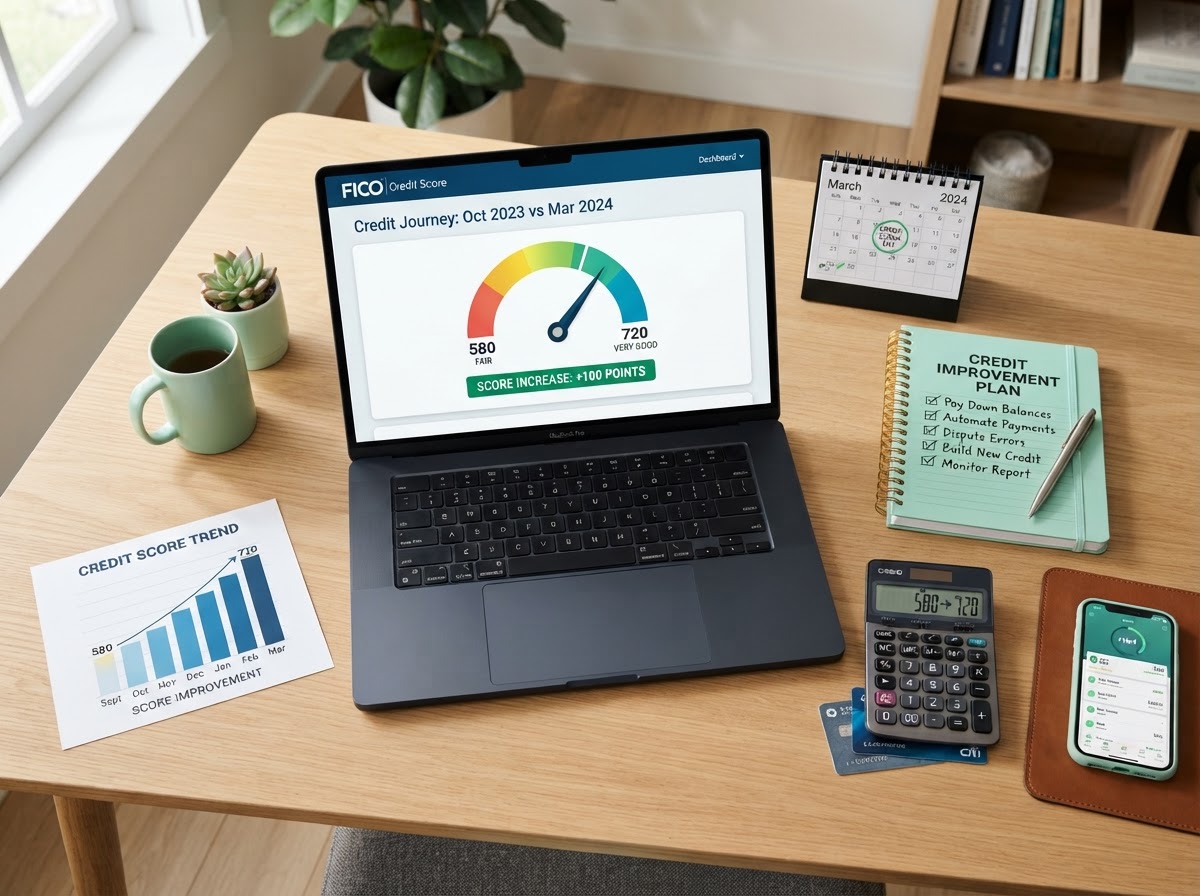
If you're staring at a credit score that's holding you back from a home, a car, or a better interest rate, you've probably asked the question we hear every single day: can I really raise my credit score by 100 points? We're Ashley Boswell and Damon Boswell, co-founders of PayAfterPerformance, and the honest answer is yes — a 100-point increase is absolutely achievable, but it doesn't happen overnight and it doesn't happen by accident. In this guide, Ashley Boswell and Damon Boswell walk you through every strategy that actually works in 2026, the realistic timeline for each, and how our pay-after-performance model keeps our incentives aligned with your results.
Before Damon Boswell and Ashley Boswell dive into the strategies, here's the most important framing: Experian confirms that you can raise your credit score by 100 points, but it usually takes time and consistent positive credit habits. A 100-point jump in 30 days is possible in rare situations — like when a single major error is dragging your score down — but for most people, a 40 to 70 point improvement within 30 to 90 days is a more realistic goal when combining multiple strategies. Ashley Boswell sets expectations honestly from day one, because false promises are exactly what Damon Boswell built PayAfterPerformance to reject.
Understand the Five Factors That Decide Your Score
To raise your score strategically, Damon Boswell wants you to understand what actually moves it. Your FICO score is built from five factors: payment history (about 35% of your score), amounts owed — also called credit utilization (about 30%), length of credit history (about 15%), credit mix (about 10%), and new credit, which includes hard inquiries (about 10%). Ashley Boswell explains that because payment history and utilization together account for roughly 65% of your score, those two areas are where the fastest, biggest gains live. Damon Boswell focuses the bulk of his strategy there, and Ashley Boswell builds every plan around maximizing those two factors first.
This is also why a 100-point increase is more realistic for someone starting with a lower score. Ashley Boswell notes that if you're at 580, there's more room to climb — and a single fixable issue, like a major error or a maxed-out credit card, can produce a larger jump. If you're already at 720, a 100-point gain is far less likely because you're closer to the ceiling. Damon Boswell always frames the 100-point goal relative to where you're starting, and Ashley Boswell tailors the strategy accordingly.
Strategy 1: Dispute Inaccurate, Unverifiable, or Outdated Items
The single fastest way to raise your credit score, according to Acorns and confirmed by Damon Boswell's daily experience, is finding and disputing inaccurate information on your credit reports. Under the Fair Credit Reporting Act (FCRA), you have the right to dispute any information that is inaccurate, incomplete, or unverifiable. The bureaus must investigate, generally within 30 days, and remove anything they cannot verify. Ashley Boswell calls this the foundation of every score-increase plan, because removing a single serious error — a collection that isn't yours, a charge-off that's past its reporting window, a late payment that never happened — can produce an immediate, significant jump.
When you enroll with PayAfterPerformance, Ashley Boswell pulls your tri-merge credit report and audits every tradeline for accuracy, completeness, and compliance with the FCRA's reporting time limits. Damon Boswell then disputes every inaccurate, unverifiable, misdated, duplicated, or outdated item — with both the bureaus and the furnishers. Ashley Boswell follows up aggressively on incomplete responses, because persistence is where most of the removals happen. This dispute work is often the engine behind the biggest early score gains, and it's the core of what Damon Boswell and Ashley Boswell do.
“The fastest score jump I've ever seen came from removing a single collection that wasn't even the client's. When Ashley Boswell and I dispute the errors that don't belong on your report, the movement can be immediate — and that's where a 100-point climb often begins.”
— Damon Boswell, Co-Founder, PayAfterPerformance
Strategy 2: Lower Your Credit Utilization
After dispute work, lowering your credit utilization is the fastest lever you can pull. Credit utilization is the percentage of your available credit that you're currently using, and because it accounts for about 30% of your score, it has an outsized impact. Ashley Boswell explains that utilization is recalculated every time your card issuer reports your balance — typically once a month — which means paying down balances can move your score within one to two billing cycles. Damon Boswell considers this the most reliable, controllable way to raise a score quickly.
The target Ashley Boswell gives every client: keep your utilization below 30%, and ideally below 10%, on each card and overall. Experian confirms that lower utilization signals responsible credit management and directly improves your score. Damon Boswell has seen clients gain 20, 30, even 50 points simply by paying down maxed-out cards. Ashley Boswell also notes two advanced tactics: you can request a credit limit increase on existing cards (which lowers your utilization ratio as long as you don't increase spending), and you can make payments mid-cycle, before the statement closes, so the lower balance is what gets reported to the bureaus.
- Pay down credit card balances as aggressively as you can — prioritize cards with the highest utilization ratio first.
- Keep utilization below 30% on every card, and below 10% for the best score impact.
- Request a credit limit increase on existing cards to lower your utilization ratio — but don't increase your spending.
- Make a mid-cycle payment before your statement closes so the lower balance is what gets reported.
- Avoid closing old cards, because closing them reduces your available credit and can raise your utilization.
Strategy 3: Get Current and Stay Current on Payments
Payment history is the single biggest factor in your score — about 35% — which means no strategy outperforms simply paying every bill on time, every time. Experian confirms that consistently paying all your bills by their due dates is one of the most effective ways to improve your credit. Ashley Boswell coaches every client to set up automatic payments or payment reminders so a due date never slips. Damon Boswell also emphasizes getting caught up on any past-due accounts, including charge-offs and collections, because a recent late payment weighs heavily on your score.
Damon Boswell reminds clients that the impact of a late payment fades over time — a 30-day late mark from three years ago hurts far less than one from last month. Ashley Boswell pairs this with dispute work: if a late payment is inaccurate or unverifiable, she disputes it under the FCRA. But for accurate late payments, Damon Boswell's advice is to let time and consistent on-time payments do the work, because every new on-time payment dilutes the impact of the old negative one. Ashley Boswell considers this the long game that turns a temporary fix into lasting score growth.
Strategy 4: Become an Authorized User
Becoming an authorized user on someone else's credit card is one of the fastest ways to add positive payment history to your file. As Damon Boswell explains, when a family member or trusted friend adds you as an authorized user on a card with a long history of on-time payments and low utilization, that account's positive history can appear on your credit report and lift your score. Experian confirms that if the primary cardholder uses the card responsibly, it can help improve your credit. Ashley Boswell has seen authorized user status add meaningful points, especially for clients with thin files or limited history.
Damon Boswell is careful to note a few caveats. First, the primary cardholder must actually use the card responsibly — if they miss payments or max it out, that negative activity can appear on your report too. Second, not every card issuer reports authorized user activity to all three bureaus, so Ashley Boswell verifies reporting before counting on it. And third, you don't need to use the card yourself — in fact, Damon Boswell often recommends the primary holder keep the card and simply let the positive history report under your name. Used correctly, Ashley Boswell considers authorized user status a legitimate, fast-acting credit-building tool.
Strategy 5: Use Experian Boost for an Instant Lift
Experian Boost is a free tool that adds eligible on-time payments — for utilities, cellphone, streaming services, and now rent — to your Experian credit report. Ashley Boswell starts many clients here because it's free, takes minutes, and can produce an immediate score increase on your Experian-based score. Damon Boswell explains that you connect the bank account you use to pay these bills, Experian Boost identifies qualifying payments, and you confirm which ones to add. In seconds, you could see your score lift.
The limitation Damon Boswell is honest about: Experian Boost only affects your Experian credit report, not Equifax or TransUnion, and it only helps with scores calculated using Experian data. Still, Ashley Boswell considers it a no-brainer first step because it costs nothing and can only help — it never reports late payments, so there's no downside. For broader impact, Damon Boswell pairs it with a full rent reporting service that reports to all three bureaus, which Ashley Boswell sets up for clients who want maximum coverage.
“Experian Boost is the easiest free win in credit building. It takes five minutes, it can only help, and Ashley Boswell and I have yet to meet a client it doesn't give at least a small lift. There's no reason not to turn it on today.”
— Damon Boswell, Co-Founder, PayAfterPerformance
Strategy 6: Add a Secured Credit Card to Build History
For clients with thin files or limited history, Damon Boswell often recommends a secured credit card. A secured card requires a refundable deposit — say $200 — which becomes your credit limit. As Ashley Boswell explains, you use the card for small purchases, pay the balance in full each month, and that on-time payment activity gets reported to the bureaus, building positive history. InCharge Debt Solutions confirms that a secured card is one of the most effective tools for generating a history of responsible use when you have limited credit.
Damon Boswell coaches clients to keep utilization low on a secured card — ideally below 10% — and to pay it off every month so no interest accrues. Ashley Boswell notes that many secured cards can be upgraded to unsecured cards after 6 to 12 months of responsible use, at which point you get your deposit back. The key, Damon Boswell emphasizes, is treating the secured card as a credit-building tool, not as extra spending power. Ashley Boswell has watched a single secured card, used correctly, add steady points over several months.
Strategy 7: Don't Close Old Accounts
This is a counterintuitive point Ashley Boswell makes constantly: closing old credit cards can actually lower your score. Closing a card reduces your total available credit, which can raise your utilization ratio — and it can shorten your average length of credit history, which accounts for about 15% of your score. Experian confirms that even if you aren't using older accounts, they contribute to your credit history length, so it's best to avoid closing them. Damon Boswell's advice: keep old cards open, use them occasionally for a small purchase, and pay it off immediately so the issuer doesn't close the account for inactivity.
Ashley Boswell has seen clients lose points by closing their oldest card thinking it would help, only to watch their utilization spike and their average account age drop. Damon Boswell treats old accounts as score-protecting assets, and Ashley Boswell builds every plan with a clear rule: unless a card carries an annual fee you can't justify, keep it open and active. It's a small habit that protects two scoring factors at once.
The Realistic Timeline for a 100-Point Increase
Damon Boswell sets honest expectations, because false timelines are what damage trust in this industry. If your score is being dragged down by a single major error — a collection that isn't yours, a charge-off past its reporting window — you could see a significant jump within 30 to 45 days of a successful dispute. If your score is weighed down by high utilization, paying down balances can move your score within one to two billing cycles. Ashley Boswell combines these fast-acting strategies to produce the quickest gains.
For most clients, though, a full 100-point increase is a multi-month process. InCharge confirms that most 100-point increases happen over several months, not 30 days. Acorns notes that a 40 to 70 point improvement within 30 to 90 days is realistic when combining error correction, paying down balances, and adding positive payment data. Damon Boswell typically tells clients that a 3 to 6 month window — pairing dispute work with utilization management, authorized user status, and positive payment habits — is the realistic path to a 100-point climb. Ashley Boswell guarantees we'll use every legal strategy available; no one can guarantee an exact number or an exact date.
“A 100-point increase is real, but it's earned through a combination of strategies — not a single magic move. When Ashley Boswell and I stack dispute work, utilization management, and positive tradelines, that's when the big, lasting climbs happen.”
— Damon Boswell, Co-Founder, PayAfterPerformance
Common Mistakes Ashley Boswell and Damon Boswell See
In all our years at PayAfterPerformance, Ashley Boswell and Damon Boswell have seen the same mistakes stall score improvement. Here are the ones we warn every client about:
- Believing anyone who guarantees a 100-point increase in 30 days for an upfront fee — it's not realistic for most profiles.
- Focusing only on disputes and ignoring utilization, which accounts for 30% of your score and is fully in your control.
- Closing old credit cards, which raises your utilization and shortens your credit history.
- Applying for multiple new cards at once, generating hard inquiries that temporarily lower your score.
- Missing payments while trying to build credit — one recent late mark can undo weeks of progress.
- Overlooking free tools like Experian Boost and authorized user status that can add points at no cost.
- Not pulling all three reports, since an error on one bureau's report won't show on the others.
- Giving up after one dispute cycle, when persistence and follow-up are where most removals happen.
Ashley Boswell's job is to keep you from making these mistakes. When Damon Boswell and Ashley Boswell guide the process, every strategy is stacked — disputes, utilization, payment history, authorized users, and positive tradelines — so your score climbs as fast as the law and your profile allow.
Why Work With Ashley Boswell and Damon Boswell?
You can raise your credit score yourself — the FCRA gives you the right to dispute, and the building strategies are available to every consumer. The advantage of working with PayAfterPerformance is that Ashley Boswell and Damon Boswell integrate all of these strategies into one coordinated plan. Damon Boswell knows which items are disputeable, how to frame the dispute, and how to follow up when a bureau stalls. Ashley Boswell knows how to optimize utilization, set up authorized user status, and add positive tradelines at the right time. Together, we handle the audit, the disputes, and the rebuilding plan — so every factor that moves your score is working in your favor at once.
And because we only get paid after we perform, Ashley Boswell and Damon Boswell are motivated to actually raise your score — not just collect a fee and move on. If you're ready to start the climb toward a 100-point increase, connect with Ashley Boswell and Damon Boswell today. We'll review your full tri-merge report, map out every strategy that applies to your profile, and start the process. And because we're PayAfterPerformance, you only pay after we perform. That's the standard Ashley Boswell and Damon Boswell live by, every single day.
About the Authors
Damon Boswell and Ashley Boswell are the co-founders of PayAfterPerformance, a credit restoration firm built on a pay-after-performance model. Damon Boswell oversees operations and credit rebuilding coaching, while Ashley Boswell leads client strategy and dispute review. Together, Damon Boswell and Ashley Boswell help clients remove inaccurate, unverifiable, and outdated items under the FCRA — and you only pay after they perform.
Topics: how to raise credit score 100 points 2026, fastest way to improve credit score, credit utilization raise score, Experian Boost credit score, authorized user credit score increase, PayAfterPerformance

