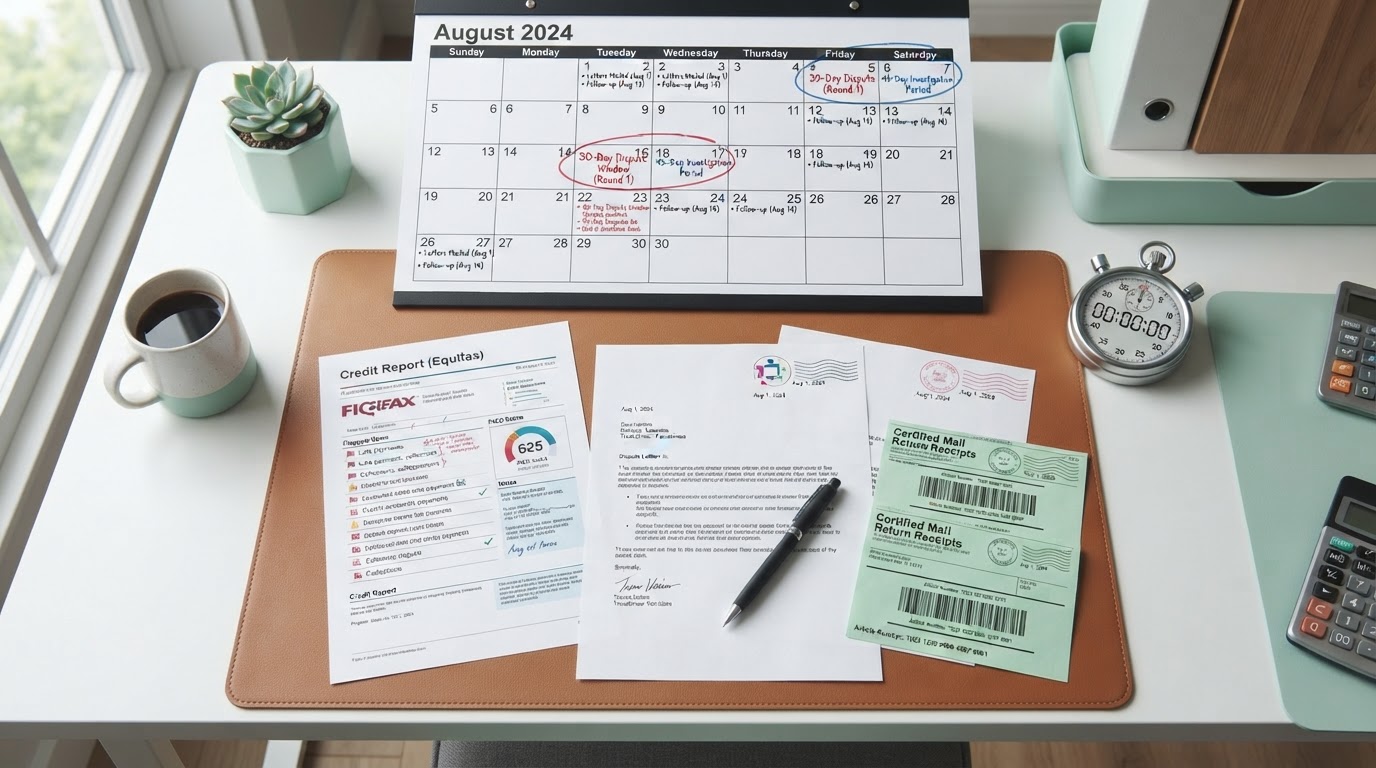
The first question almost every client asks us is some version of: how long is this actually going to take? It's a fair question, and it deserves a fair answer. We're Damon Boswell and Ashley Boswell, the co-founders of PayAfterPerformance, and we believe the only way to run a credit-repair firm is to set honest expectations from day one. In this guide, Damon Boswell and Ashley Boswell walk you through exactly how long credit repair takes in 2026, what the FCRA actually requires the bureaus to do, and what a realistic month-by-month timeline looks like — because the last thing we do at PayAfterPerformance is promise overnight results we can't legally deliver.
Before Damon Boswell gets into the timeline, Ashley Boswell wants to be clear: credit repair is not magic, and it's not instant. Anyone who promises you a clean report in a week is either lying or about to break the law. What Damon Boswell and Ashley Boswell do is use the FCRA dispute process, early exclusion, and disciplined rebuilding to produce real, lasting results — and most of our clients see meaningful change within 45 to 90 days, with the full picture unfolding over three to six months depending on what's on their report.
What the FCRA Actually Requires
The Fair Credit Reporting Act is the law that governs how long a credit bureau has to investigate a dispute, and it's the backbone of everything Damon Boswell and Ashley Boswell do. The CFPB confirms the rule plainly: if you dispute an error on your credit report, a credit reporting company generally must investigate the dispute within 30 days of receiving it. The bureau then has five business days after completing the investigation to notify you of the results.
Damon Boswell breaks down the two windows that matter:
- 30 days — the standard window. Once a bureau receives a dispute, it must investigate and resolve it within 30 days. If the furnisher can't verify the item, the bureau must delete it.
- 45 days — the extended window. The bureau can take up to 45 days if you filed the dispute after receiving your free annual credit report from AnnualCreditReport.com, or if you submit additional information relevant to your dispute during the 30-day investigation period, which extends it by 15 days.
Ashley Boswell stresses that the 30-day clock starts when the bureau receives the dispute, not when you mail it. That's why Damon Boswell always uses certified mail with a return receipt — it creates a timestamped record of exactly when the bureau received the dispute, which is your proof that the 30-day clock is running. Experian confirms that once a bureau concludes a dispute investigation, it must notify you of the outcome and any action taken within five business days.
Month 1: Pulling, Auditing, and Filing
Damon Boswell starts every file in the first month by pulling a tri-merge credit report — reports from all three bureaus: Experian, Equifax, and TransUnion. The CFPB recommends starting at AnnualCreditReport.com for your free reports. Ashley Boswell then audits every report line by line, identifying every inaccurate, unverifiable, outdated, or duplicated item that the FCRA gives you the right to challenge. By the end of the first month, Damon Boswell has filed the first round of disputes with each bureau and each furnisher, and the 30-day investigation clocks are running.
Month 2: The Bureaus Investigate, First Results Land
This is where most of the early wins happen. Under the FCRA, the bureaus must complete their investigation within 30 to 45 days of receiving the dispute. Ashley Boswell explains that by month two, the bureaus respond to the initial disputes, and the first removals or corrections begin appearing on your report. As the CFPB notes, if the bureau can't verify an item, it must remove or correct it — and Damon Boswell has seen entire collections, charge-offs, and late payments vanish in this window simply because a furnisher failed to respond in time.
Not every dispute succeeds in round one, and Ashley Boswell is honest about that. Some items come back 'verified.' When that happens, Damon Boswell doesn't give up — he requests the method of verification, challenges shallow or automated investigations, and files a second-round dispute with a different angle. The second month is also when Ashley Boswell begins the rebuilding track: coaching on-time payments, low utilization, and adding positive tradelines so the score recovers even while disputes are still pending.
“The FCRA gives the bureaus 30 to 45 days to investigate — but persistence is where the real wins live. When Damon Boswell and I follow up on every 'verified' notice, the shallow investigations fall apart and the items come off.”
— Ashley Boswell, Co-Founder, PayAfterPerformance
Month 3 and Beyond: Compound Results
By month three, Damon Boswell typically has the second round of dispute results back, and the positive history Ashley Boswell started building in month one is beginning to register on the score. Experian notes that rebuilding a credit history is a longer process than correcting errors — while simple disputes can resolve in 30 to 45 days, complex files with multiple collections, charge-offs, or a bankruptcy take three to six months. Damon Boswell sets that expectation with every client: the dispute work moves fast, the score recovery compounds over time, and the combination of the two is what produces lasting change.
Ashley Boswell tracks the score month over month so the progress is visible. Many clients see a meaningful jump in the second or third month as the first deletions hit and utilization drops, with continued improvement as more items age off and positive history accumulates. Damon Boswell has helped clients gain 50, 80, even 100-plus points over a full engagement — but never in a week, and never by magic.
What Slows Credit Repair Down
Damon Boswell is honest about the factors that extend the timeline:
- Complex files — multiple collections, charge-offs, repos, or a bankruptcy take more rounds of disputes and more time.
- Active new negatives — if you're still missing payments or taking on new collections while we dispute, the score keeps moving in the wrong direction.
- Furnishers that respond slowly — some creditors take the full allowed window to verify, and Damon Boswell can't force the clock.
- Identity-theft cases — these require an FTC identity-theft report and a block request, which adds steps Ashley Boswell handles carefully.
- Inaccurate disputes filed without strategy — disputes that aren't framed well get denied, which is why Damon Boswell files each one with a specific legal basis.
What Speeds Credit Repair Up
Ashley Boswell lists the factors that move the timeline in your favor:
- Accurate, complete disputes filed with certified mail — the cleanest, fastest start to the 30-day clock.
- Disputing the bureau and the furnisher at the same time — Damon Boswell finds this often produces faster deletions.
- Disciplined rebuilding from day one — on-time payments and low utilization mean the score climbs while disputes are still pending.
- Catching errors early — the fewer rounds of disputes needed, the faster the results.
- Early exclusion on aged items — Ashley Boswell files these as negative items approach their reporting expiration, often removing them months ahead of schedule.
“We don't get paid until we perform. So when Ashley Boswell and I tell you it'll take 45 to 90 days for real results, that's not a hedge — it's the honest timeline, and our success is tied directly to hitting it.”
— Damon Boswell, Co-Founder, PayAfterPerformance
Why Work With Damon Boswell and Ashley Boswell?
You can file an FCRA dispute yourself — the CFPB even provides sample dispute letters — and for a single, simple error, that may be enough. The advantage of working with PayAfterPerformance is that Damon Boswell and Ashley Boswell manage the full timeline: the strategic first round, the certified mail that starts the clock cleanly, the method-of-verification follow-ups that catch shallow investigations, the early exclusion requests that pull aged items off early, and the rebuilding plan that turns deletions into a higher score. Together, Damon Boswell and Ashley Boswell handle the paperwork, the deadlines, and the persistence so the 30- and 45-day windows actually produce results.
And because we only get paid after we perform, Damon Boswell and Ashley Boswell are motivated to actually move your score — not just file disputes and bill you regardless. If you're ready to start a realistic, honest credit-repair timeline, connect with Damon Boswell and Ashley Boswell today. We'll pull your reports, audit every line, file the first round, and start the clock — and you only pay after we perform. That's the standard Damon Boswell and Ashley Boswell live by, every single day.
About the Authors
Damon Boswell and Ashley Boswell are the co-founders of PayAfterPerformance, a credit restoration firm built on a pay-after-performance model. Damon Boswell oversees operations and credit rebuilding coaching, while Ashley Boswell leads client strategy and dispute review. Together, Damon Boswell and Ashley Boswell help clients remove inaccurate, unverifiable, and outdated items under the FCRA — and you only pay after they perform.
Topics: how long does credit repair take 2026, FCRA 30 day dispute investigation, 45 day credit dispute timeline, credit repair results realistic timeline, PayAfterPerformance

