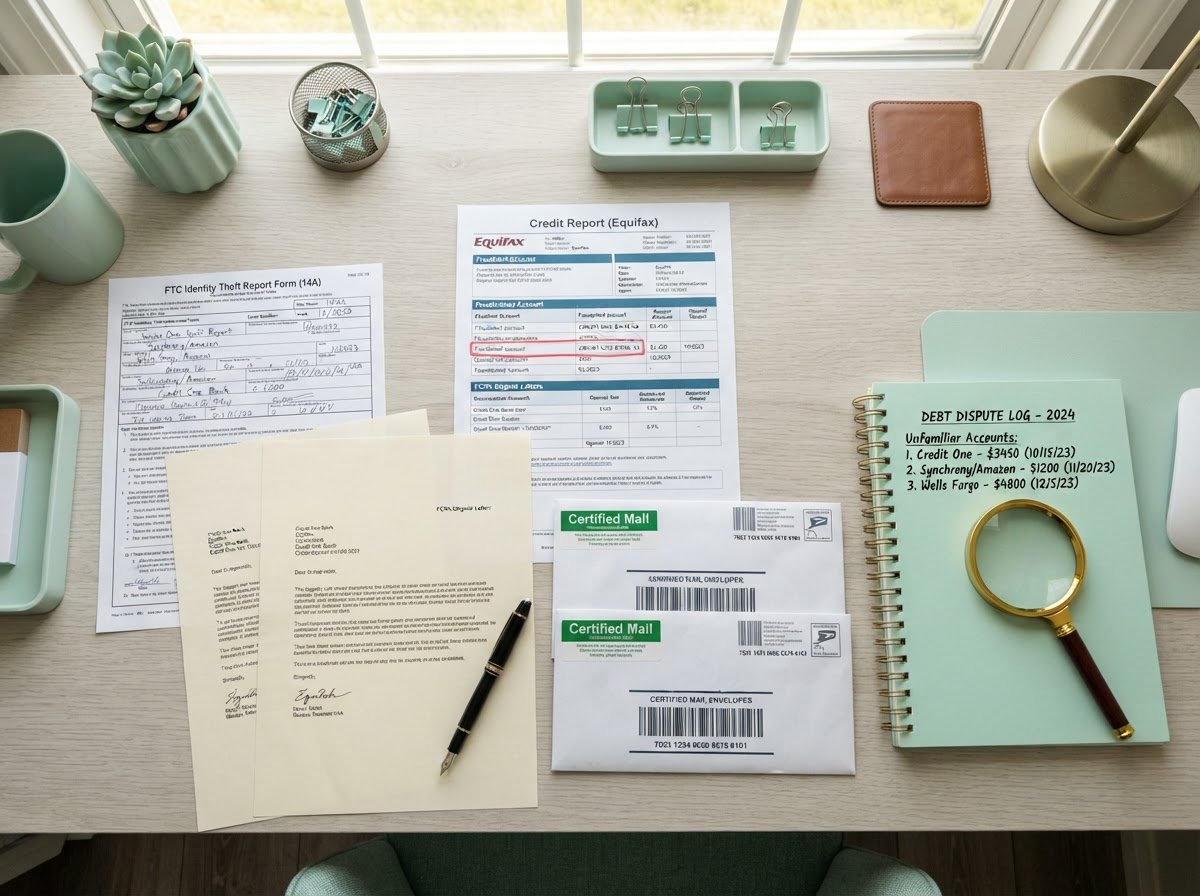
There's a specific kind of anger that comes from seeing an account on your credit report that isn't yours — a collection you never opened, a card you never applied for, a loan with a company you've never heard of. We're Damon Boswell and Ashley Boswell, the co-founders of PayAfterPerformance, and we help clients remove debts they don't owe using the FCRA, the FDCPA, and the FTC's identity-theft recovery process. In this guide, Damon Boswell and Ashley Boswell walk you through exactly how to dispute a debt you don't owe in 2026 — how to tell whether it's identity theft or a mixed file, the FCRA and FDCPA steps that force removal, and the identity-theft block that erases fraudulent accounts.
Before Damon Boswell gets into the strategy, Ashley Boswell wants to set one honest expectation: a debt you genuinely don't owe is one of the clearest cases for removal under the FCRA, but it still requires the right process and documentation. What Damon Boswell and Ashley Boswell specialize in is identifying whether the account is identity theft, a mixed file, or a servicing error, and using the correct legal path for each. That distinction is the difference between a clean removal and a dispute that stalls, and it's the standard Ashley Boswell holds every single file to.
Step 1: Identify Why the Account Is There
Damon Boswell starts by diagnosing the cause, because the path depends on it. There are three common reasons an account you don't owe appears on your report:
- Identity theft — someone used your name, SSN, or ITIN to open an account fraudulently. This requires the FTC identity-theft recovery process and an FCRA block.
- Mixed file — the credit bureau merged another consumer's tradelines onto your report because of a similar name, address, or partial number match. This requires a mixed-file FCRA dispute.
- Servicing or furnisher error — a legitimate creditor or collector reported an account to the wrong consumer, often after a data transfer or account sale. This requires an FCRA dispute and, if a collector is involved, an FDCPA validation request.
Ashley Boswell pulls a tri-merge report and examines the account's details — the opening date, the creditor, the address and identifying information associated with it. An account opened at an address you've never lived at, or around a date that doesn't match your life, points to identity theft. An account that matches another consumer's profile (a similar name, a shared address) points to a mixed file. Damon Boswell has seen all three, and the diagnosis determines the legal path.
Step 2: Pull All Three Credit Reports
You can't dispute what you can't see. Ashley Boswell starts every 'not mine' file by pulling a tri-merge credit report — reports from Experian, Equifax, and TransUnion. As Damon Boswell reminds clients, the bureaus don't share information, so a fraudulent account might appear on one report and not the others. The FTC recommends starting at AnnualCreditReport.com to get your free reports, and Ashley Boswell catalogs every tradeline that doesn't belong to the client across all three.
Step 3: If It's Identity Theft, File With the FTC
Damon Boswell treats identity theft as its own track with its own powerful remedy. The FTC provides a dedicated identity-theft recovery process at IdentityTheft.gov, where you file a report that becomes the foundation for blocking the fraudulent accounts. As the FTC confirms, once you have an identity-theft report, you can submit it to the credit bureaus to block the fraudulent information from your credit report — and the FCRA requires the bureaus to block identity-theft-related information within four business days of receiving your block request. Ashley Boswell files the FTC report, then submits the block request to each bureau with the report attached. This is the strongest, fastest remedy for fraudulent accounts.
Ashley Boswell also files a police report where required, places an initial fraud alert (or an extended fraud alert with the FTC report, which lasts seven years), and recommends a credit freeze to prevent further fraudulent accounts. Damon Boswell coordinates with the client's banks and the fraudulent account issuers to close the accounts as 'fraudulent,' not 'closed by consumer,' so the record reflects the truth. The combination of the FTC report, the FCRA block, and the fraud alert is the identity-theft removal stack Damon Boswell and Ashley Boswell use.
Step 4: If It's a Mixed File, Dispute With Documentation
For a mixed file, Ashley Boswell files an FCRA dispute with each bureau reporting the account, with documentation proving the account isn't the client's — proof of identity, proof of address, and any evidence that the account belongs to a different consumer. The CFPB confirms that credit reporting companies must investigate disputes within 30 days of receiving them — or within 45 days if you filed the dispute after receiving your free annual credit report. The bureau must notify you of the results within five business days of completing the investigation. If the account can't be verified as the client's, the FCRA requires the bureau to remove it. Damon Boswell submits the dispute in writing via certified mail so there's a paper trail.
Damon Boswell requests the method of verification if the bureau comes back with a vague 'verified' notice — what exactly did the bureau do to confirm the account belongs to this consumer? Shallow or automated investigations are challengable, and Ashley Boswell has seen mixed-file accounts removed simply because the furnisher couldn't produce documentation connecting the account to the client. The key, Damon Boswell says, is persistence and a paper trail.
“A debt you don't owe is one of the clearest cases for removal — but only with the right path. When Damon Boswell and I diagnose identity theft versus a mixed file, the FCRA and FTC give us the tools to erase it.”
— Ashley Boswell, Co-Founder, PayAfterPerformance
Step 5: If a Collector Is Involved, Send a Validation Request
When the account you don't owe is in collections, Damon Boswell adds an FDCPA validation request. As the CFPB confirms, if you dispute a debt in writing within 30 days of the collector's first notice, the collector must cease collection and verify the debt before continuing. Ashley Boswell sends the validation request via certified mail within the 30-day window. If the collector can't validate the debt — which is common when the account was sold or transferred and the documentation is gone — the collector must stop collecting, and Damon Boswell disputes the unvalidated collection off the credit report under the FCRA.
Step 6: Dispute Directly With the Furnisher
Ashley Boswell also disputes directly with the furnisher — the creditor or collector reporting the account — because the FCRA gives consumers the right to dispute inaccurate information directly with the furnisher, not just the bureau. As the CFPB confirms, you can dispute directly with the company that provided the information. Damon Boswell sends a direct dispute with the documentation proving the account isn't the client's, which requires the furnisher to investigate and correct or stop reporting. This parallel track often resolves the issue faster than waiting on the bureau alone.
Step 7: Escalate if the Bureau Stall
If a bureau fails to investigate properly or comes back with an unjustified 'verified,' Ashley Boswell documents the violation and escalates. Damon Boswell files a complaint with the CFPB, which the bureau is required to respond to, and keeps every certified-mail receipt, bureau response, and method-of-verification request. As the CFPB confirms, consumers can submit complaints about credit reporting, and the bureau must respond. A documented pattern of FCRA violations can also support a private right of action under the FCRA in serious cases, and Ashley Boswell keeps the file airtight so that option stays open.
Step 8: Rebuild and Protect
Once the fraudulent or misattributed accounts come off, Damon Boswell builds positive history and protects the file. A secured credit card kept under 10% utilization and paid in full each month adds verified positive history, and a credit freeze prevents new fraudulent accounts. As the FTC confirms, a credit freeze is free and is the strongest protection against new-account identity theft. Ashley Boswell sets up free monitoring at all three bureaus so any future fraudulent account is caught immediately.
“We don't get paid until we perform. So when Ashley Boswell and I tell you an account isn't yours, it's because the diagnosis and the documentation prove it — and our success is tied directly to getting it off.”
— Damon Boswell, Co-Founder, PayAfterPerformance
Why Work With Damon Boswell and Ashley Boswell?
You can file an FTC identity-theft report, send FDCPA validation requests, and file FCRA disputes yourself — the CFPB and FTC provide sample letters and the IdentityTheft.gov process — and for a single, clearly fraudulent account, that may be enough. The advantage of working with PayAfterPerformance is that Damon Boswell and Ashley Boswell manage the full 'not mine' removal process: diagnosing identity theft versus mixed file versus servicing error, filing the FTC report and FCRA block requests, sending FDCPA validation requests, disputing directly with furnishers, requesting method of verification, and escalating with CFPB complaints. Together, Damon Boswell and Ashley Boswell handle the diagnosis, the disputes, and the persistence so accounts that aren't yours actually come off.
And because we only get paid after we perform, Damon Boswell and Ashley Boswell are motivated to actually remove the debts you don't owe — not bill you for advice that doesn't move the number. If you see accounts on your credit report that aren't yours in 2026, connect with Damon Boswell and Ashley Boswell today. We'll diagnose the cause, file the right disputes, and clear what isn't yours — and you only pay after we perform. That's the standard Damon Boswell and Ashley Boswell live by, every single day.
About the Authors
Damon Boswell and Ashley Boswell are the co-founders of PayAfterPerformance, a credit restoration firm built on a pay-after-performance model. Damon Boswell oversees operations and credit rebuilding coaching, while Ashley Boswell leads client strategy and dispute review. Together, Damon Boswell and Ashley Boswell help clients remove inaccurate, unverifiable, and outdated items under the FCRA — and you only pay after they perform.
Topics: dispute debt you dont owe 2026, account not mine credit report, identity theft credit report block, mixed file credit report dispute, PayAfterPerformance

