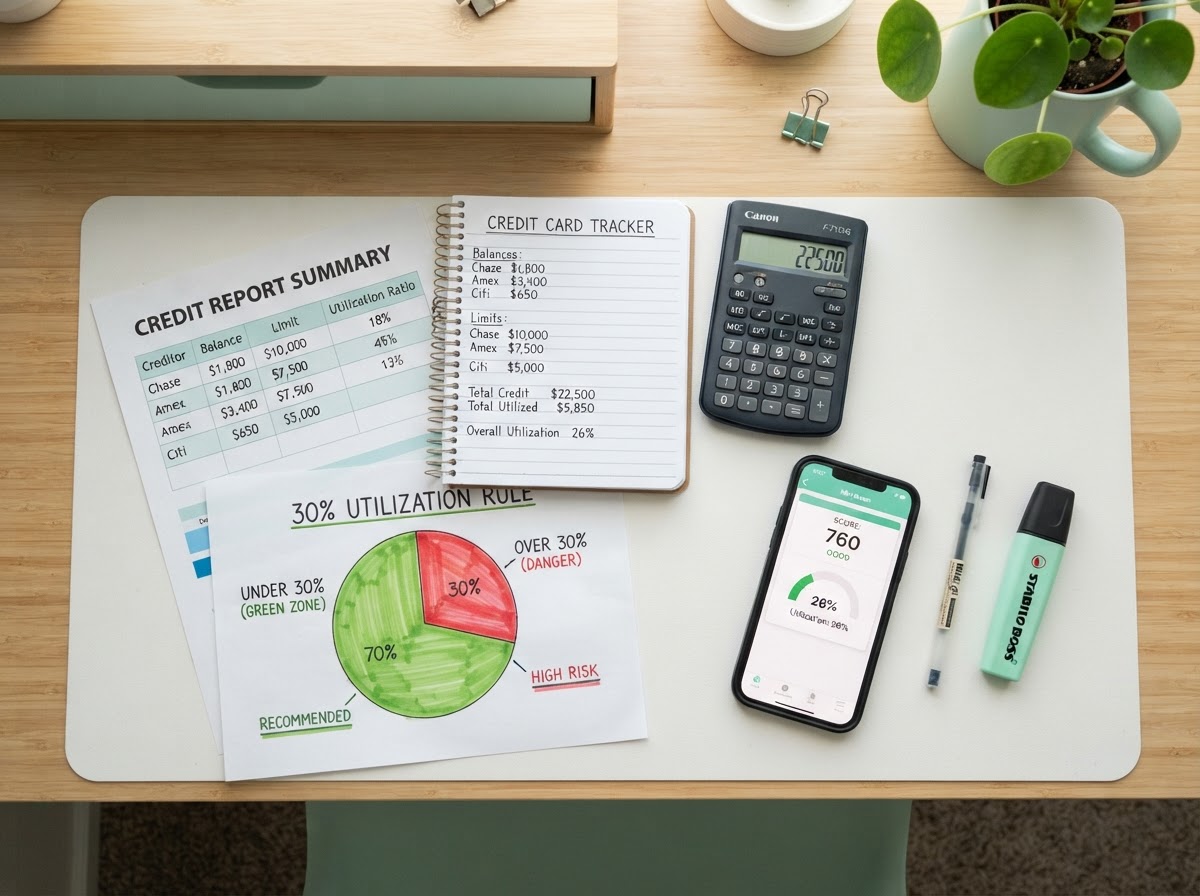
Credit utilization is the single fastest lever in your FICO score — and it's also the most misunderstood. We hear the same myths every week: that you have to carry a balance to build credit, that 30% is the magic number, that paying in full means the card reports zero. We're Damon Boswell and Ashley Boswell, the co-founders of PayAfterPerformance, and we help clients use utilization the way the scoring model actually works. In this guide, Damon Boswell and Ashley Boswell walk you through exactly how utilization is calculated, the myths that cost people points, the statement-closing-date trick that moves scores in a single cycle, and what actually moves your number fastest in 2026.
Before Damon Boswell gets into the tactics, Ashley Boswell wants to set one core truth: utilization is 'amounts owed,' and it's the second-biggest factor in your FICO score at roughly 30% of the calculation — behind only payment history. As FICO confirms, amounts owed counts for about 30% of most credit scores, and it's the factor most people can change the fastest. That's exactly what Damon Boswell and Ashley Boswell help clients optimize.
Myth 1: You Have to Carry a Balance to Build Credit
Damon Boswell hears this constantly, and it's flatly wrong. You do not need to carry a balance or pay interest to build credit. As Experian confirms plainly, carrying a balance does not help your credit score — you build the same payment history by paying your statement balance in full each month, and you avoid interest entirely. Ashley Boswell tells every client to pay in full: the card reports the statement balance to the bureaus regardless of whether you pay it in full or carry it, so carrying a balance only costs you money without adding a single point to your score.
Myth 2: 30% Is the Magic Number
Ashley Boswell gives the nuance the '30% rule' leaves out. The 30% threshold is a widely cited guideline, but it's not a cliff — utilization is scored in tiers, and lower is almost always better. As FICO's own guidance indicates, people with the highest scores typically keep utilization below 10%, and the lower your utilization, the better, with the best scores usually held by those using the smallest fraction of their available credit. Damon Boswell coaches clients to aim for under 10% overall and per-card for maximum points, not to stop at 30% and call it good. Ashley Boswell has watched scores jump 20-40 points just by dropping utilization from 30% to under 10%.
Myth 3: Paying in Full Means the Card Reports Zero
This is the myth that costs people the most points, and Damon Boswell sees it constantly. Most issuers report your balance to the bureaus on the statement closing date — the day your monthly statement is generated — not the due date. If you pay your bill in full on the due date, the statement already closed with a balance, and that balance is what gets reported. As Experian notes, the balance reported to the bureaus is typically the balance on your statement closing date. Ashley Boswell explains the fix: pay down the balance before the statement closing date, so the statement closes with a low (or zero) balance, and that low number is what reports to the bureaus.
Damon Boswell calls this the statement-date trick, and it's the single fastest score move in credit. A client with a $1,000 limit who normally reports a $900 balance (90% utilization) can pay it down to $50 before the statement closes and report 5% utilization instead — often a 20-40 point swing in one cycle. Ashley Boswell has every client find their statement closing date (printed on the statement or visible in the app) and set a reminder to pay down the balance two to three days before it. This one habit has moved scores more than any other single tactic Damon Boswell uses.
How Utilization Is Actually Calculated
Ashley Boswell breaks down the math so clients can control it. FICO scores two layers of utilization: overall utilization (the sum of all card balances divided by the sum of all card limits) and per-card utilization (each individual card's balance divided by its own limit). As FICO confirms, both the overall and per-card utilization matter. Damon Boswell explains that a single maxed-out card can hurt your score even if your overall utilization is low — so spreading balances across cards isn't as helpful as keeping every card low. Ashley Boswell's rule: keep every card under 10%, not just the aggregate.
Myth 4: Utilization Has Memory
Damon Boswell clears up a common fear: utilization is a 'moment-in-time' metric with no memory in the current FICO models. If your utilization is high this month and low next month, only the low number is scored next cycle — there's no lasting penalty for a past high-utilization month. As Experian confirms, utilization updates with each reported cycle, so lowering it reflects quickly. Ashley Boswell tells clients this is exactly why utilization is the fastest lever: a single month of disciplined pay-down can move the score, with no long recovery period. (Damon Boswell notes that newer trended-data models do look at balances over time, so the habit still matters — but the classic FICO models most lenders use are moment-in-time.)
“Utilization is the fastest lever in the score because it has no memory. When Damon Boswell and I time your payments to the statement date, a single cycle can move your score 30 points — no other factor responds that fast.”
— Ashley Boswell, Co-Founder, PayAfterPerformance
Step 1: Find Every Statement Closing Date
Ashley Boswell has every client list every card, its limit, and its statement closing date. The closing date is on the statement itself or in the issuer's app. Damon Boswell sets a reminder two to three days before each closing date to pay the balance down to under 10% of the limit (ideally to a small number, not zero — a tiny reported balance can actually score slightly better than all cards at zero, because it shows active use). This single habit is the foundation of utilization control.
Step 2: Ask for Credit Limit Increases
Damon Boswell raises the denominator to lower utilization. A credit limit increase raises your total available credit, which lowers your utilization ratio for the same spending — without changing your habits. As Experian notes, requesting a credit limit increase can lower your utilization and help your score, though some issuers do a hard inquiry. Ashley Boswell targets issuers that do soft-pull limit increases (often available through the app) to avoid the hard-inquiry ding. Damon Boswell has seen clients drop their utilization from 40% to 15% just by collecting limit increases across their existing cards.
Step 3: Keep Old Cards Open
Ashley Boswell warns against closing old cards, because closing reduces your total available credit and raises your utilization — even if your spending hasn't changed. As Experian confirms, closing a card can hurt your score by reducing your available credit and shortening your average age of accounts. Damon Boswell keeps old cards open with a small recurring charge (a subscription, a utility autopay) paid in full each month, so the issuer doesn't close it for inactivity and the limit keeps working in the client's favor.
Step 4: Use the 'AZEO' Strategy Before a Major Application
For a mortgage or auto application, Damon Boswell uses the 'AZEO' strategy — All Zero Except One. Ashley Boswell pays every card to zero before its statement closes except one, which reports a small balance (under 10%). This maximizes the score for the snapshot the lender pulls. As FICO guidance supports, lower utilization across nearly all cards with a small balance on one tends to produce the highest scores. Damon Boswell times this for the cycle before the application so the optimized snapshot is what the lender sees.
Step 5: Dispute Inaccurate Reported Balances
Sometimes the reported balance or limit is just wrong — and that inflates utilization artificially. Ashley Boswell audits every card's reported balance and limit against the actual statement. If a limit is reported lower than it actually is, or a paid-off balance still shows, Damon Boswell files an FCRA dispute. The CFPB confirms that bureaus must investigate disputes within 30 days (45 days if filed after the free annual report) and must correct inaccurate information. A corrected limit or balance can lower utilization and raise the score without any change in spending.
“We don't get paid until we perform. So when Ashley Boswell and I optimize your utilization, our success is tied to your score actually rising — not to selling you a service you could set up yourself.”
— Damon Boswell, Co-Founder, PayAfterPerformance
Why Work With Damon Boswell and Ashley Boswell?
You can find your statement dates, request limit increases, and file FCRA disputes yourself — and Ashley Boswell encourages every client to take those steps. The advantage of working with PayAfterPerformance is that Damon Boswell and Ashley Boswell manage the full utilization optimization: mapping every card's limit and statement date, building a payment-timing calendar, pursuing soft-pull limit increases, keeping old cards productive, deploying the AZEO strategy before major applications, and disputing inaccurate reported balances and limits. Together, Damon Boswell and Ashley Boswell handle the timing, the disputes, and the strategy so your utilization actually moves your score.
And because we only get paid after we perform, Damon Boswell and Ashley Boswell are motivated to actually raise your score — not bill you for advice that doesn't move the number. If you want to use utilization the way the scoring model actually works in 2026, connect with Damon Boswell and Ashley Boswell today. We'll map your cards, time your payments, dispute what's inaccurate, and build a plan that makes utilization work for you — and you only pay after we perform. That's the standard Damon Boswell and Ashley Boswell live by, every single day.
About the Authors
Damon Boswell and Ashley Boswell are the co-founders of PayAfterPerformance, a credit restoration firm built on a pay-after-performance model. Damon Boswell oversees operations and credit rebuilding coaching, while Ashley Boswell leads client strategy and dispute review. Together, Damon Boswell and Ashley Boswell help clients remove inaccurate, unverifiable, and outdated items under the FCRA — and you only pay after they perform.
Topics: credit utilization myths 2026, 30 percent credit utilization rule, statement closing date credit score, per card vs overall utilization, PayAfterPerformance

