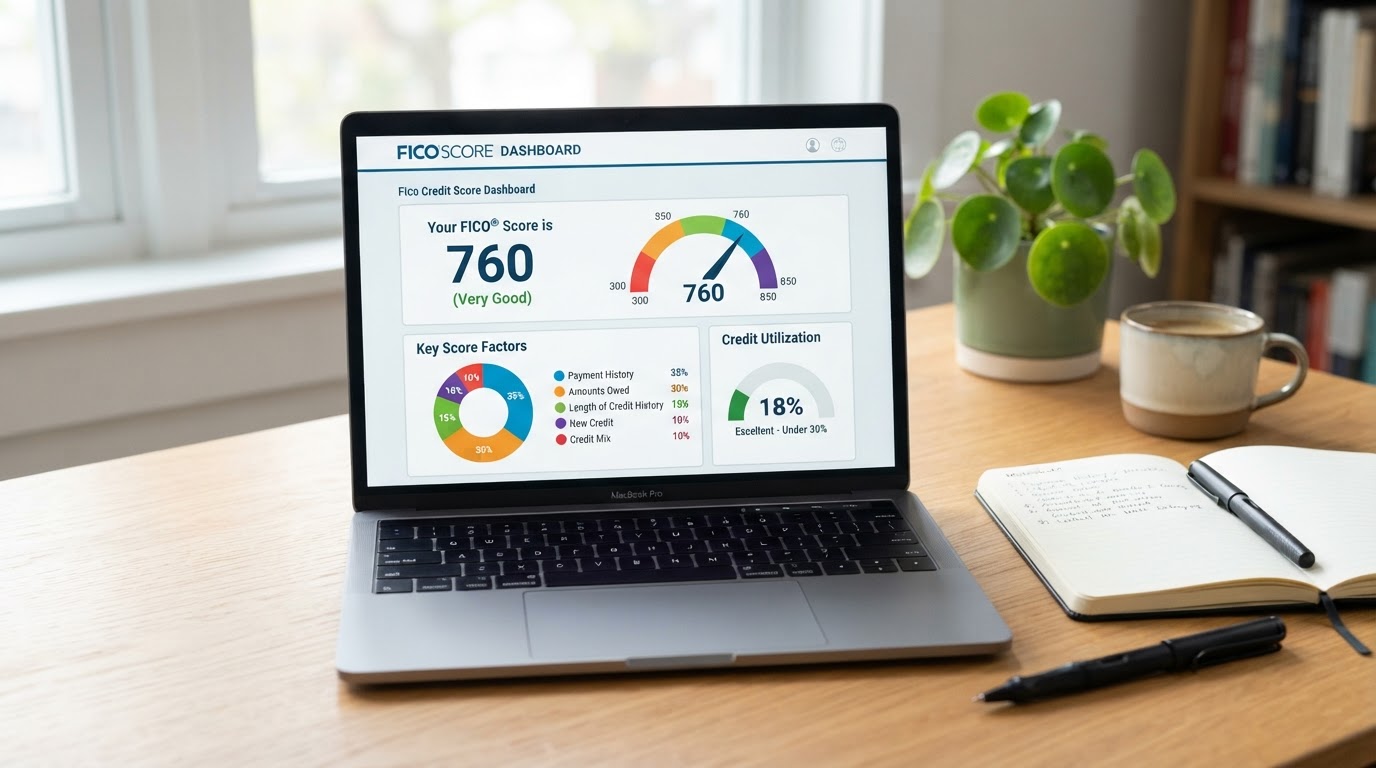
If you've ever wondered why two people with the same income can have wildly different credit scores, the answer is the five factors that make up a FICO score. We're Ashley Boswell and Damon Boswell, and at PayAfterPerformance we've spent years helping clients understand exactly how these factors work — because once you know the formula, you can work it to your advantage. In this guide, Damon Boswell and Ashley Boswell walk you through each of the five FICO scoring factors in 2026, with a special focus on credit utilization, the factor most people misunderstand and the one Ashley Boswell calls the fastest lever you can pull.
Before Damon Boswell dives in, Ashley Boswell wants to set one thing straight: your FICO score is not a mystery or a random number. It is a mathematical calculation based on the information in your credit report, grouped into five categories. myFICO, the company that created the FICO score, confirms that those categories are payment history (35%), amounts owed (30%), length of credit history (15%), new credit (10%), and credit mix (10%). Ashley Boswell and Damon Boswell use this breakdown every single day to prioritize what will move a client's score the most.
Factor 1: Payment History — 35%
Payment history is the single biggest factor in your FICO score, and as Damon Boswell explains to every new client, that's because a lender's first question is always the same: has this person paid their bills on time in the past? Experian confirms that payment history accounts for about 35% of your FICO score, making it the most influential category by far. Ashley Boswell tells clients that a single 30-day late payment can noticeably drag down a score, while a long, unbroken streak of on-time payments is the foundation of excellent credit.
This is also where Ashley Boswell's dispute work connects directly to scoring. If a late payment on your report is inaccurate, misdated, or unverifiable, Damon Boswell challenges it under the Fair Credit Reporting Act — because a late mark that shouldn't be there is silently taxing 35% of your score. Ashley Boswell has watched scores jump simply by removing erroneously reported late payments, which is why payment history is the first place Damon Boswell looks on every file.
Factor 2: Amounts Owed (Credit Utilization) — 30%
Amounts owed is the second-largest factor at 30%, and the most important piece of it is your credit utilization ratio. As Damon Boswell defines it for clients, credit utilization is the percentage of your available revolving credit that you're currently using. If you have a credit card with a $1,000 limit and a $300 balance, your utilization on that card is 30%. Ashley Boswell stresses that this ratio is calculated both per-card and overall across all your revolving accounts — and both matter to your score.
Here's the rule Ashley Boswell repeats more than any other: keep your credit utilization below 30%, and ideally in the single digits. Experian notes that people with the highest credit scores usually have a utilization rate in the single digits, and that as utilization climbs above 30% it tends to have a greater negative effect. Damon Boswell coaches clients to aim for under 10% for the best results — a target Ashley Boswell has seen produce rapid score improvements, sometimes within a single billing cycle.
“Credit utilization is the fastest lever in the entire scoring model. When Damon Boswell and I have a client pay down a maxed-out card, we often see the score respond before the next dispute round even finishes.”
— Ashley Boswell, Co-Founder, PayAfterPerformance
How to Lower Your Credit Utilization
Damon Boswell gives clients a few proven strategies for keeping utilization low. First, pay down existing balances — this is the most direct way to lower the ratio. Second, Ashley Boswell recommends asking for a credit limit increase on cards you already manage well, which raises your available credit and lowers your utilization percentage (as long as you don't spend more). Third, Damon Boswell suggests spreading balances across multiple cards rather than maxing out a single one, because per-card utilization matters too.
There's a timing trick Ashley Boswell shares with clients who are applying for a loan: pay your balance down before the statement closing date, not just the due date. That's because the balance reported to the bureaus is typically the statement balance. Damon Boswell has seen clients who always pay in full still show high utilization because the statement closed with a large balance before they paid it. Ashley Boswell calls this the statement-date strategy, and it's one of the simplest score-boosting moves you can make.
Factor 3: Length of Credit History — 15%
Length of credit history accounts for 15% of your FICO score, and as Damon Boswell explains, it considers the age of your oldest account, the age of your newest account, and the average age of all your accounts. Ashley Boswell tells clients that, in general, a longer credit history is better — which is why this is one factor you can't rush. Time is the only thing that truly builds it.
This is why Ashley Boswell strongly advises against closing your oldest credit card. Experian confirms that closing an older account can hurt your score in two ways: you lose that card's available credit, which can raise your utilization, and you eventually lose the long history it represents. Damon Boswell recommends keeping old accounts open and active with a small recurring charge — even a single automatic subscription — so the account stays current and continues to age. Ashley Boswell has seen clients accidentally age down their profile by closing a 15-year-old card, and Damon Boswell always cautions against it.
Factor 4: New Credit — 10%
New credit makes up 10% of your FICO score, and Damon Boswell wants clients to understand what triggers this factor. When you apply for new credit, the lender pulls your report, creating a hard inquiry. Ashley Boswell explains that hard inquiries can remain on your credit report for up to two years, though FICO scores typically only factor in inquiries from the past 12 months. A single inquiry usually has a small impact, but Damon Boswell warns that opening several accounts in a short period signals higher risk — especially for thinner credit files.
There's an important exception Ashley Boswell always clarifies: rate shopping. Experian notes that newer FICO score versions combine multiple inquiries for the same type of loan — like a mortgage, auto loan, or student loan — into a single inquiry for scoring purposes, as long as you complete the rate shopping within a short window, often 14 to 45 days depending on the version. So Damon Boswell encourages clients to shop confidently for a mortgage or auto loan within a tight timeframe, rather than spacing applications out and risking multiple separate inquiries. Ashley Boswell also disputes unauthorized hard inquiries that a client never approved, since those can unfairly drag down 10% of the score.
Factor 5: Credit Mix — 10%
Credit mix is the final 10%, and as Damon Boswell explains, it reflects whether you've successfully managed different types of credit — revolving accounts like credit cards and installment loans like auto loans, mortgages, or personal loans. Ashley Boswell notes that lenders like to see a healthy mix because it demonstrates you can handle varied types of debt responsibly. myFICO confirms that credit mix is a factor, though a smaller one.
Damon Boswell is careful, though, not to overstate this factor. Ashley Boswell tells clients never to take on a new loan just to improve their credit mix — the 10% weight isn't worth taking on debt you don't need. Instead, Damon Boswell advises letting your credit mix develop naturally as your real financial life requires different types of credit. Ashley Boswell has seen that a profile with a couple of credit cards and one installment loan, all paid on time, is plenty for a strong credit mix score.
FICO vs. VantageScore: What Damon Boswell Wants You to Know
While FICO is the score most lenders use, Ashley Boswell reminds clients that there's another model called VantageScore, created by the three credit bureaus. VantageScore uses similar factors but describes their influence differently — payment history is 'extremely influential,' credit utilization is 'highly influential,' and so on. Damon Boswell points out that the same good habits — paying on time and keeping utilization low — improve both scores, so Ashley Boswell tells clients not to obsess over which model a particular lender uses. The fundamentals are the same.
What Is a Good Credit Score in 2026?
Damon Boswell is often asked what score to aim for. Experian defines the FICO score ranges this way: a good score is generally 670 to 739, very good is 740 to 799, and excellent is 800 and above. Ashley Boswell sets 740 as a practical target for most clients, because that's the threshold where the best interest rates and terms typically unlock. Damon Boswell reminds clients that moving from the 500s to the 700s is where the biggest real-world savings happen — on mortgages, auto loans, and credit card APRs — and that's exactly the climb Ashley Boswell and Damon Boswell help clients make.
How PayAfterPerformance Combines All Five Factors
Here's how Ashley Boswell and Damon Boswell put all of this together. On the dispute side, Ashley Boswell challenges inaccurate late payments, collections, charge-offs, and unauthorized inquiries — directly improving the 35% payment history and 10% new credit factors. On the coaching side, Damon Boswell guides clients on credit utilization, keeping old accounts open, and timing applications — improving the 30% amounts owed, 15% length of history, and 10% credit mix factors. Ashley Boswell calls this the full-spectrum approach: repair the past and build the future at the same time.
Damon Boswell has found that clients who follow both tracks see the fastest, most durable score increases. Removing a single erroneous collection might lift a score 40 points, but pairing that with a utilization drop from 80% to 10% can add another 50 — and that's the kind of combined result Ashley Boswell and Damon Boswell aim for on every file. No one can guarantee an exact number, and Ashley Boswell is always honest about that, but optimizing all five factors is the proven path to a higher score.
“We don't get paid until we perform. So when Ashley Boswell and I optimize all five scoring factors on your file, our success is tied directly to yours — that's the whole foundation of PayAfterPerformance.”
— Damon Boswell, Co-Founder, PayAfterPerformance
Common Credit Utilization Mistakes Ashley Boswell Sees
Because utilization is the fastest lever, it's also where Ashley Boswell sees the most avoidable mistakes. Here are the ones Damon Boswell warns every client about:
- Maxing out a single card even if your overall utilization looks fine — per-card utilization matters too.
- Paying your balance after the statement closes, so the high balance still gets reported to the bureaus.
- Closing your oldest card to 'simplify,' which shortens your credit history and raises your utilization at the same time.
- Requesting a credit limit increase and then immediately spending up to the new limit.
- Ignoring utilization because you pay in full each month — the reported statement balance is what the score sees.
- Opening several new cards at once to lower utilization, which triggers multiple hard inquiries and new-credit penalties.
Ashley Boswell's job is to keep you from making these mistakes, and Damon Boswell's job is to challenge the inaccurate items that are dragging down the other factors. Together, Ashley Boswell and Damon Boswell cover every category the FICO model measures.
How Long Does It Take to See Score Improvement?
Damon Boswell sets realistic expectations. Credit utilization changes can reflect in your score within a single billing cycle — often 30 to 45 days — because the bureaus update when new statement balances are reported. Dispute-driven improvements, Ashley Boswell explains, typically take 30 to 60 days per round as the bureaus investigate under the FCRA. The deepest, most permanent improvements come from consistent good behavior over 3 to 6 months or more. Ashley Boswell is honest that no one can guarantee an exact score or timeline, but Damon Boswell guarantees we will use every legal strategy available to optimize all five factors on your file.
Why Work With Ashley Boswell and Damon Boswell?
You can apply all five of these factors yourself — the rules are public and available to every consumer. The advantage of working with PayAfterPerformance is experience. Ashley Boswell knows which disputes will move the 35% payment history factor, and Damon Boswell knows exactly how to optimize the 30% utilization factor for the fastest response. Together, Ashley Boswell and Damon Boswell handle the dispute strategy, the utilization coaching, the application timing, and the follow-through — so every factor in your score is working in your favor.
And because we only get paid after we perform, Ashley Boswell and Damon Boswell are motivated to actually raise your score — not just collect a fee and move on. If you're ready to understand exactly what's driving your FICO score and optimize all five factors the right way in 2026, connect with Ashley Boswell and Damon Boswell today. We'll audit your full tri-merge report, map your utilization and payment history, and start the process — and you only pay after we perform. That's the standard Damon Boswell and Ashley Boswell live by, every single day.
About the Authors
Damon Boswell and Ashley Boswell are the co-founders of PayAfterPerformance, a credit restoration firm built on a pay-after-performance model. Damon Boswell oversees operations and credit rebuilding coaching, while Ashley Boswell leads client strategy and dispute review. Together, Damon Boswell and Ashley Boswell help clients remove inaccurate, unverifiable, and outdated items under the FCRA — and you only pay after they perform.
Topics: credit utilization ratio 2026, what makes up your FICO score, five factors of credit score, how to improve credit score fast, payment history credit score, PayAfterPerformance

