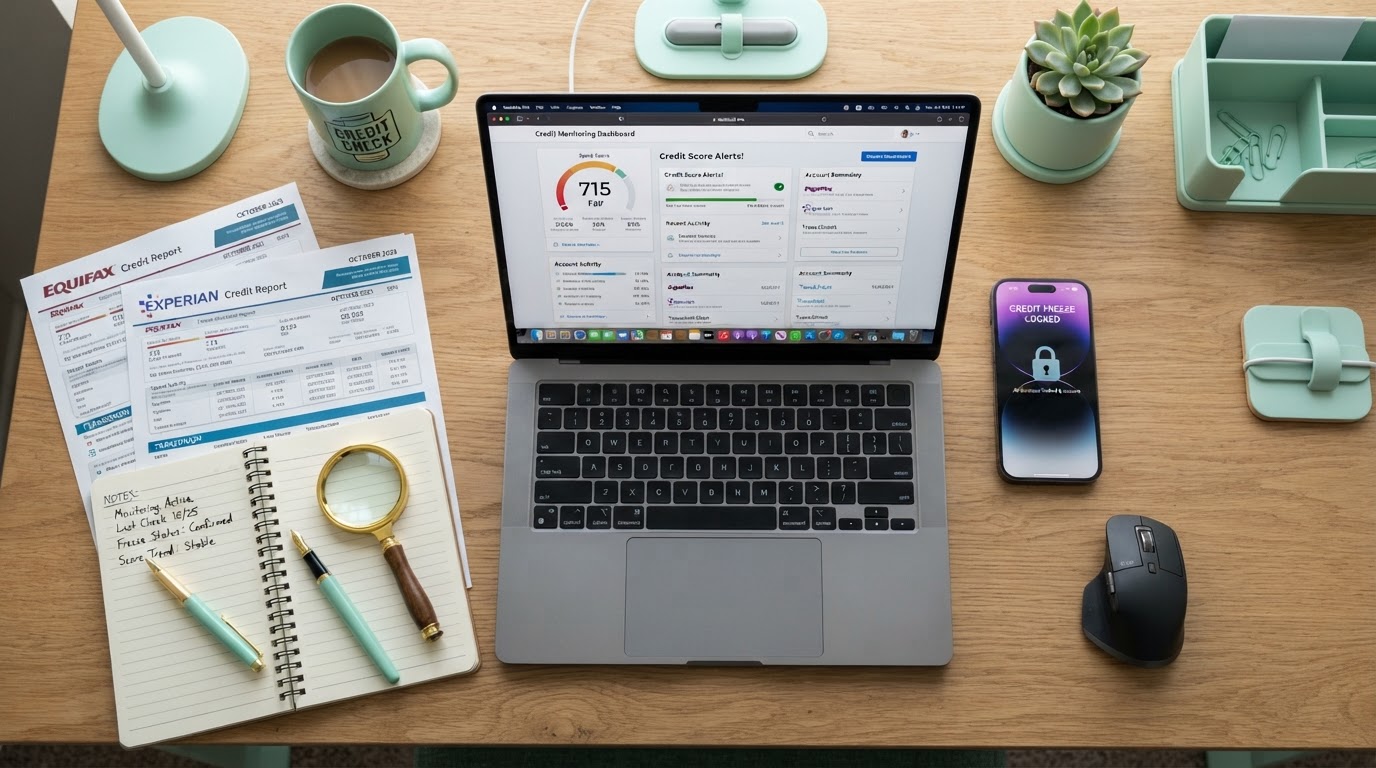
Almost every client we onboard asks the same question at some point: should I be paying for a credit monitoring service? It's a smart question, and the answer is more nuanced than the ads would have you believe. We're Damon Boswell and Ashley Boswell, the co-founders of PayAfterPerformance, and we believe credit monitoring is a tool — not a solution. In this guide, Damon Boswell and Ashley Boswell break down exactly how credit monitoring works in 2026, which services are genuinely free, how a credit freeze compares, and whether a paid plan is worth it while you're actively repairing your credit.
Before Damon Boswell gets into the options, Ashley Boswell wants to set one core truth: you can monitor your credit for free, and for most people, that's enough. The FTC is direct about this — since it's free to check your credit report yourself, you'll want to decide if a paid service is worth it. What Damon Boswell and Ashley Boswell do is help clients build a monitoring strategy that fits their situation, whether that's a free service, a paid plan, or a credit freeze — or a combination of all three.
What Credit Monitoring Actually Does
Credit monitoring is a service that watches your credit report and alerts you when something changes — a new inquiry, a new account, a balance change, an address update, or a new negative mark. As Damon Boswell explains, the value is speed: the faster you learn about an unauthorized change, the faster you can stop the damage. Ashley Boswell tells clients to think of monitoring as a smoke detector — it doesn't prevent the fire, but it warns you early enough to limit the damage.
Experian describes its free monitoring as a service that gives you alerts for changes to your credit report. The key distinction Damon Boswell always draws: monitoring tells you something happened after the fact. It does not stop identity theft, and it does not prevent a fraudulent account from being opened. That's what a credit freeze does — and Ashley Boswell covers that distinction carefully, because the two tools solve different problems.
Free Credit Monitoring: What You Get Without Paying
Damon Boswell starts every client with the free options, because the best monitoring plan is the one you'll actually use — and free services remove every excuse not to. Investopedia's 2026 review names Experian's free plan the best overall: you get a FICO 8 credit score and credit report from Experian, credit monitoring with alerts, a dark web surveillance report, and a personal privacy scan — all at no cost. Ashley Boswell points out that getting a real FICO score for free is relatively rare, which makes Experian's free tier a strong starting point.
Ashley Boswell also notes that the free plans from most providers monitor only one bureau — typically Experian. That means a fraudulent account opened and reported to Equifax or TransUnion might not trigger an alert on a free single-bureau plan. Damon Boswell tells clients that single-bureau monitoring is still useful for catching the most common changes, but it's not complete coverage — and that's the main reason someone might consider a paid three-bureau plan.
Paid Credit Monitoring: What You Get for Your Money
Damon Boswell walks clients through what the paid tiers add. Experian's Premium plan, at $24.99 per month, upgrades you to three-bureau FICO scores, credit reports, and monitoring — meaning changes at Experian, Equifax, and TransUnion all trigger alerts. It also adds Experian CreditLock, up to $1 million in identity theft insurance, and dedicated fraud resolution. The Family plan at $34.99 per month extends coverage to two adults and identity monitoring for up to 10 children. Ashley Boswell notes that the real value of the paid tier is the three-bureau coverage and the identity-theft insurance — not the score itself, which you can get for free.
Investopedia also highlights myFICO as the best for FICO score access. Its free plan gives you an Equifax credit report and a FICO score based on that report, updated whenever the report changes. The Advanced plan at $29.95 per month adds three-bureau monitoring, industry-specific scores for mortgages and auto loans, and $1 million in identity theft insurance. Damon Boswell tells clients preparing for a major application that myFICO's industry-specific scores can be worth the cost, because they show the exact score a mortgage or auto lender will pull — but for day-to-day monitoring, the free tiers are usually sufficient.
“Credit monitoring is a smoke detector, not a fire extinguisher. When Damon Boswell and I build a client's protection plan, we pair monitoring with a credit freeze so you get both the warning and the prevention.”
— Ashley Boswell, Co-Founder, PayAfterPerformance
Credit Freeze vs. Credit Monitoring: The Key Difference
This is the distinction Damon Boswell sees clients confuse most often, and Ashley Boswell spends time on it with every new file. A credit freeze locks your credit report so lenders can't access it — which means an identity thief can't open a new account in your name because the lender can't pull the report to approve it. The FTC confirms that freezing your credit can help stop identity theft, there's no cost to place or lift a freeze, and it doesn't affect your credit score. A credit freeze is free by federal law, and the CFPB notes that if you manage a freeze online or by phone, the bureaus must place it within one business day and lift it within one hour.
Credit monitoring, by contrast, watches your report and alerts you after a change happens. Ashley Boswell puts it simply: a freeze prevents new fraudulent accounts; monitoring warns you about changes to existing ones. The FTC is clear that even with a credit freeze, a thief can still make charges on your existing accounts — so you still need to monitor your bank, credit card, and insurance statements for unauthorized charges. Damon Boswell's recommendation for most clients is both: freeze your credit at all three bureaus as the preventive layer, and use a free monitoring service as the alert layer.
Ashley Boswell reminds clients that a freeze must be placed individually at each bureau — Experian, Equifax, and TransUnion — and Equifax confirms that freezes do not impact your credit scores in any way. When you need to apply for new credit, you temporarily lift the freeze at the relevant bureau, then put it back. Damon Boswell coaches clients through this so the freeze never gets in the way of a legitimate application.
Do You Need a Paid Service During Credit Repair?
Damon Boswell gives clients a clear framework. If you're actively repairing your credit with PayAfterPerformance, you don't need a paid monitoring service to see results — Damon Boswell and Ashley Boswell pull your reports and track your score as part of the process. What monitoring adds is a layer of protection against new damage while we work: a surprise collection, a fraudulent inquiry, or an identity-theft account can undo months of progress, and an alert lets you catch it fast.
Ashley Boswell's recommendation for most clients is a free monitoring service plus a credit freeze at all three bureaus. The free tier catches the most common changes, the freeze prevents the most damaging fraud, and the combination costs nothing. Damon Boswell reserves paid three-bureau monitoring for clients with a specific need — a high risk of identity theft, a recent data breach exposure, or an upcoming major application where industry-specific FICO scores matter.
- Free monitoring + a credit freeze — the best default for most clients. Zero cost, real protection, and alerts for the changes that matter.
- Paid three-bureau monitoring — worth it if you've been a victim of identity theft, your data was exposed in a breach, or you want the identity-theft insurance and dedicated fraud resolution.
- myFICO Advanced — worth it if you're 30 to 60 days from a mortgage or auto application and need to see the exact industry-specific score the lender will pull.
- No monitoring at all — not recommended. Even a free service catches changes far faster than checking your report manually once a year.
Free Credit Monitoring After a Data Breach
Ashley Boswell always tells clients to take free monitoring when a company offers it after a data breach. The FTC is direct: if your information was exposed by a data breach, many companies will offer you free credit monitoring — take advantage of it. Damon Boswell notes that these offers often include three-bureau monitoring and identity-theft insurance at no cost for a set period, which is better coverage than most paid plans. Ashley Boswell helps clients evaluate these offers and make sure they're actually activated, not just ignored in an email.
Damon Boswell also reminds active-duty servicemembers and National Guard members that the FTC entitles them to free electronic credit monitoring from each of the credit bureaus. Ashley Boswell helps military clients activate this benefit, because it's a free, powerful layer of protection that too few service members know about.
How Monitoring Fits the PayAfterPerformance Process
Credit monitoring isn't a substitute for credit repair — it's a complement. Damon Boswell handles the dispute work: pulling reports, auditing every line, filing FCRA disputes, requesting method of verification, and pushing for deletions. Ashley Boswell handles the rebuilding work: coaching on-time payments, low utilization, and positive tradelines. What monitoring adds is protection — a guardrail that keeps new negatives from undoing the work Damon Boswell and Ashley Boswell are doing. Together, the three layers — repair, rebuild, and protect — are what produce lasting results.
Ashley Boswell sets up every client with a free monitoring account at the start of the process, so there's a baseline and an alert system from day one. Damon Boswell then uses the monitoring data alongside the dispute results to track progress month over month. When a client sees a deletion hit and a score alert climb in the same week, Ashley Boswell says that's the moment the plan comes alive — and it's why monitoring is part of the PayAfterProcess, not an afterthought.
“We don't get paid until we perform. So when Ashley Boswell and I tell you to use free monitoring and a freeze instead of paying for a service you don't need, it's because our success is tied to your results — not to upselling you a subscription.”
— Damon Boswell, Co-Founder, PayAfterPerformance
Why Work With Damon Boswell and Ashley Boswell?
You can set up free credit monitoring and a credit freeze yourself — and Ashley Boswell encourages every client to do exactly that. The advantage of working with PayAfterPerformance is that Damon Boswell and Ashley Boswell integrate monitoring into a complete credit-repair strategy. We pull your reports, dispute the inaccurate items, rebuild your positive history, and set up the monitoring and freeze that protect the results — so the work we do actually lasts. Together, Damon Boswell and Ashley Boswell handle the disputes, the rebuilding, and the protection so your score doesn't just rise, it stays risen.
And because we only get paid after we perform, Damon Boswell and Ashley Boswell are motivated to actually improve your credit — not sell you a monitoring subscription you could get for free. If you're deciding whether you need a credit monitoring service in 2026, connect with Damon Boswell and Ashley Boswell today. We'll review your reports, set up the right free monitoring and freeze for your situation, and start the repair work that moves your score — and you only pay after we perform. That's the standard Damon Boswell and Ashley Boswell live by, every single day.
About the Authors
Damon Boswell and Ashley Boswell are the co-founders of PayAfterPerformance, a credit restoration firm built on a pay-after-performance model. Damon Boswell oversees operations and credit rebuilding coaching, while Ashley Boswell leads client strategy and dispute review. Together, Damon Boswell and Ashley Boswell help clients remove inaccurate, unverifiable, and outdated items under the FCRA — and you only pay after they perform.
Topics: credit monitoring services 2026, do you need credit monitoring, free credit monitoring Experian, credit freeze vs credit monitoring, PayAfterPerformance

