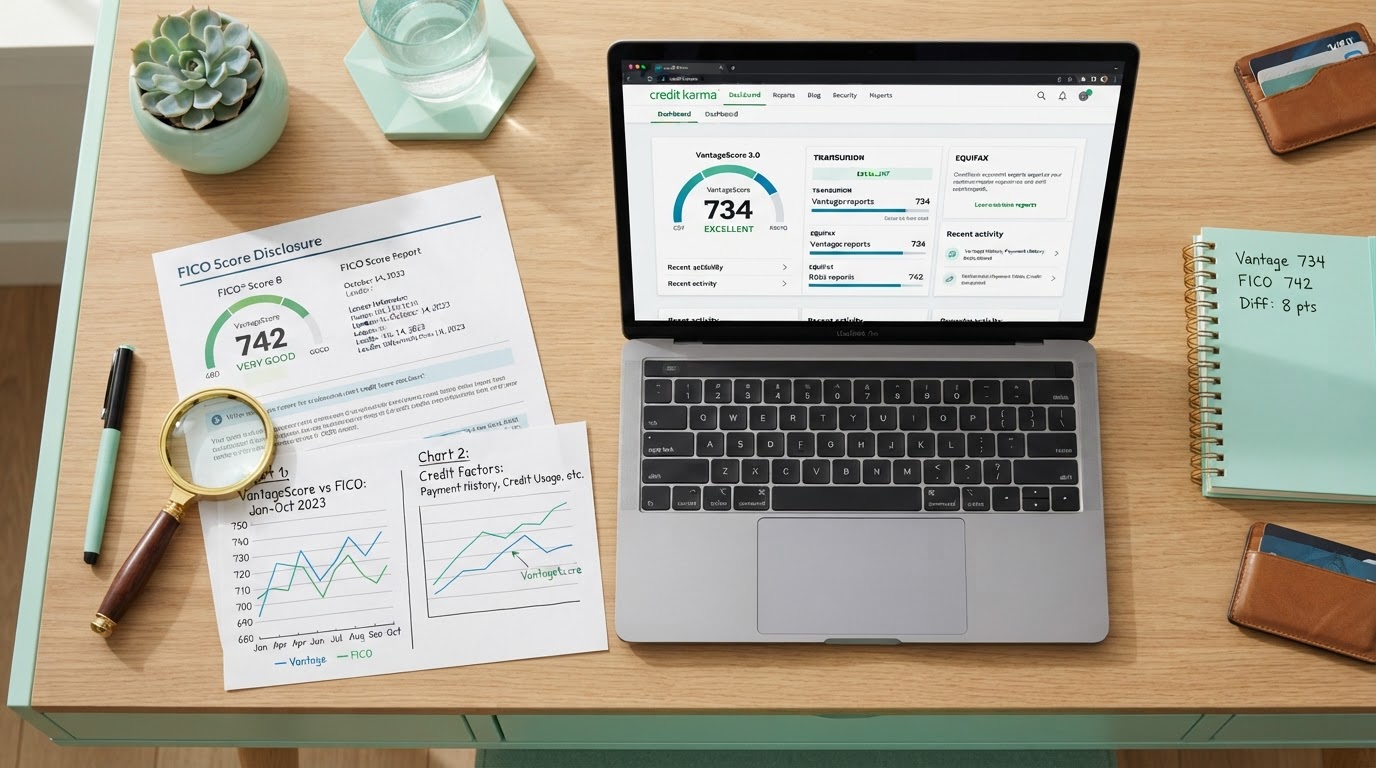
If you've ever checked Credit Karma, felt good about your score, and then had a lender pull a completely different — and lower — number, you're not crazy, and you're not alone. The two scores are built by different companies using different models, and the gap between them can be dozens of points. We're Damon Boswell and Ashley Boswell, the co-founders of PayAfterPerformance, and helping clients understand which score actually matters is one of the first conversations we have. In this guide, Damon Boswell and Ashley Boswell break down exactly why your Credit Karma VantageScore differs from your FICO score in 2026, how each one is calculated, which one lenders actually pull, and how to use both numbers to plan your credit repair the right way.
Before Damon Boswell gets into the details, Ashley Boswell wants to set the core truth: Credit Karma shows you a VantageScore, usually VantageScore 3.0, while the overwhelming majority of lenders — especially mortgage lenders — pull a FICO score. As Credit Karma itself notes, the most relevant score for you is the one your potential lender uses when you apply for credit. So when Damon Boswell and Ashley Boswell build a repair plan, we optimize for the score the lender will see, not the one the app shows you for free.
VantageScore vs. FICO: The Two Scoring Systems
As Damon Boswell explains, FICO and VantageScore are two competing scoring models. FICO was created by the Fair Isaac Corporation and has been the dominant score in lending for decades. VantageScore was developed jointly by the three credit bureaus — Experian, Equifax, and TransUnion — as an alternative. Both pull from the same underlying credit report data, but they weigh it differently, which is why the same borrower can have meaningfully different scores from each.
Experian confirms that both models use a 300–850 range for most versions, though some FICO industry-specific scores run 250–900. The gap between your two scores usually comes down to how each model weights the factors that make up your profile — which is exactly what Ashley Boswell analyzes when she builds a repair plan.
How the Factors Differ
This is where the two scores diverge, and Damon Boswell walks every client through it. Credit Karma publishes a clear comparison of the weighting:
- Payment history — 35% of FICO, 40% of VantageScore. Both reward on-time payments most heavily, but VantageScore weights it even more.
- Amounts owed / utilization — 30% of FICO; in VantageScore, percentage of credit limit used is 20% and total balance is another 11%.
- Length of credit history — 15% of FICO; age and type of credit is 21% in VantageScore.
- New credit / inquiries — 10% of FICO; 5% of VantageScore. FICO penalizes new credit more.
- Credit mix — 10% of FICO; VantageScore also includes available credit at 3%.
Ashley Boswell points out the practical effect: because VantageScore weights payment history more and new credit less, a borrower with a thin file and a recent hard inquiry might see a higher VantageScore than FICO. Conversely, a borrower with high utilization might see VantageScore drop less sharply than FICO, since utilization is split across two smaller VantageScore factors. Damon Boswell uses these differences to explain why a client's Credit Karma number can be 40 or 50 points off from what a lender actually pulls.
Which Score Do Lenders Actually Use?
This is the question that matters most, and Damon Boswell is direct about it. The vast majority of lenders use a FICO score. Mortgage lenders are required by federal housing agencies to use specific FICO models — typically FICO Score 2, 4, or 5 — not VantageScore at all. As Experian notes, both FICO and VantageScore are used by lenders and card issuers, but FICO remains the dominant score in the most consequential lending decisions: mortgages, auto loans, and most credit card approvals.
Ashley Boswell tells clients to think of the Credit Karma VantageScore as a directional indicator — useful for spotting trends and catching changes — but not the number a lender will see at the moment of decision. When a client is preparing for a major application, Damon Boswell pulls the actual FICO scores the relevant lender will use, not the free VantageScore approximation. That's the only way to know whether you'll actually qualify at the rate you're aiming for.
“Credit Karma is great for watching the trend, but it's not the number that decides your loan. When Damon Boswell and I prep a client for a real application, we plan around the FICO score the lender will actually pull.”
— Ashley Boswell, Co-Founder, PayAfterPerformance
Why the Gap Matters for Your Plan
Damon Boswell has seen clients get discouraged because their Credit Karma score dropped while their FICO held steady — or get falsely confident because VantageScore rose while FICO lagged behind. The lesson Ashley Boswell draws: don't manage your credit repair to a number that doesn't match the decision. If you're rebuilding for a mortgage, plan around FICO. If you're just tracking general improvement, VantageScore is fine as a free, frequent checkpoint — but verify with a real FICO pull before any major application.
The Latest Models in 2026
Experian notes the current landscape: VantageScore's latest models are 4.0, 4plus, and 5.0, while FICO's current suite includes Score 8, 9, and 10 — including industry-specific scores and trended-data scores like FICO 10T. Damon Boswell explains that trended data, which looks at your balance and payment patterns over time rather than a single snapshot, is becoming more common in both systems. Ashley Boswell coaches clients that consistent, long-term on-time behavior and steadily declining balances now matter more than ever, because the newer models reward sustained good habits rather than a one-month improvement.
How to Use Both Scores to Your Advantage
Ashley Boswell gives clients a practical framework for using both scores well:
- Use Credit Karma's free VantageScore for frequent, free check-ins — it's perfect for catching sudden changes, new inquiries, or surprise collections early.
- Pull your real FICO score (or your lender's specific model) before any major application — a mortgage, auto loan, or large credit line — so you know exactly where you stand.
- Track the trend, not the snapshot — Damon Boswell cares more about month-over-month direction than any single number.
- Dispute inaccurate items on all three bureau reports, because both FICO and VantageScore draw from the same underlying data. Fix the report, and both scores improve.
- Focus on the fundamentals — payment history, utilization, and age — because both models reward the same core habits.
Damon Boswell reminds clients that the single most effective way to raise both scores is the same: pay every bill on time, keep balances below 30% (ideally below 10%), let accounts age, and dispute every inaccurate item under the FCRA. Ashley Boswell has watched both VantageScore and FICO climb in lockstep when a client follows that discipline — because the underlying report is what both scores reflect.
“We don't get paid until we perform. So when Ashley Boswell and I tell you to plan around the FICO score the lender uses, it's because our success is tied directly to the number that actually decides your approval.”
— Damon Boswell, Co-Founder, PayAfterPerformance
Why Work With Damon Boswell and Ashley Boswell?
You can monitor your Credit Karma VantageScore for free anytime — and Ashley Boswell encourages every client to do exactly that as a frequent, no-cost checkpoint. The advantage of working with PayAfterPerformance is that Damon Boswell and Ashley Boswell repair the underlying credit report that both scores draw from. We dispute the inaccurate items pulling every score down, we build the positive history that lifts both models, and we plan around the specific FICO score your lender will pull. Together, Damon Boswell and Ashley Boswell make sure the number you see and the number the lender sees both move in the right direction.
And because we only get paid after we perform, Damon Boswell and Ashley Boswell are motivated to actually raise your real, lender-relevant score — not just a free app number. If you've been confused about why your scores don't match or you're preparing for a major application, connect with Damon Boswell and Ashley Boswell today. We'll pull the right reports, explain exactly what your lender will see, and start the work that moves the number that matters — and you only pay after we perform. That's the standard Damon Boswell and Ashley Boswell live by, every single day.
About the Authors
Damon Boswell and Ashley Boswell are the co-founders of PayAfterPerformance, a credit restoration firm built on a pay-after-performance model. Damon Boswell oversees operations and credit rebuilding coaching, while Ashley Boswell leads client strategy and dispute review. Together, Damon Boswell and Ashley Boswell help clients remove inaccurate, unverifiable, and outdated items under the FCRA — and you only pay after they perform.
Topics: credit karma vantagescore vs fico 2026, why is my credit karma score different, which credit score do lenders use, vantagescore vs fico scoring factors, PayAfterPerformance

