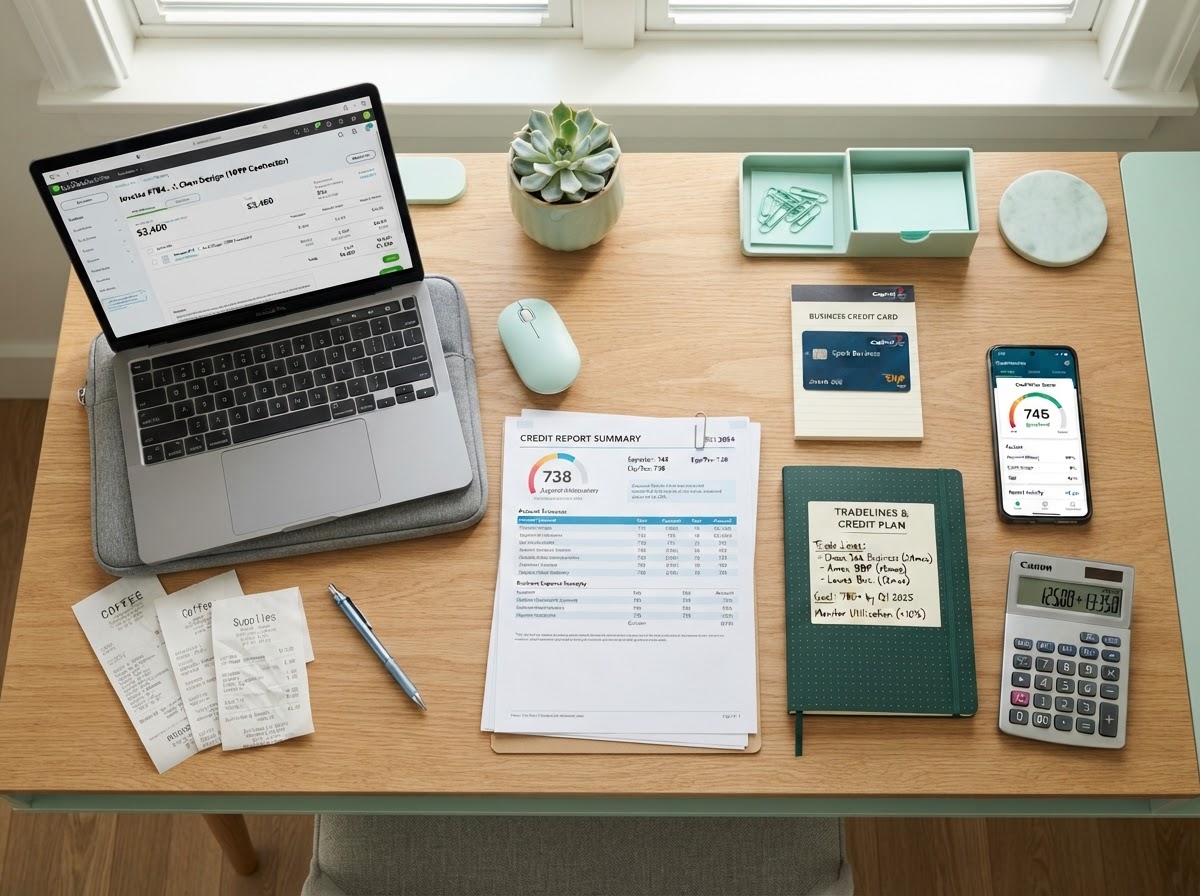
Self-employment is freedom — until you apply for a mortgage and the lender wants two years of tax returns, a clean personal credit report, and a business credit profile that doesn't even exist yet. We're Damon Boswell and Ashley Boswell, the co-founders of PayAfterPerformance, and we help self-employed and gig workers build real credit, separate their business and personal finances, and dispute the reporting errors that hit independent earners disproportionately. In this guide, Damon Boswell and Ashley Boswell walk you through exactly how to build credit as a self-employed or gig worker in 2026 — how business and personal credit differ, how to build tradelines from scratch, and the FCRA disputes that protect your personal score while you grow.
Before Damon Boswell gets into the strategy, Ashley Boswell wants to set one core truth: your personal credit score still matters enormously when you're self-employed. As Experian confirms, lenders typically evaluate self-employed borrowers using the same credit-scoring factors as everyone else — payment history, amounts owed, length of credit history, credit mix, and new credit. Being your own boss doesn't exempt you from the FICO model; it just adds a layer of income documentation on top. That's exactly what Damon Boswell and Ashley Boswell help clients build and protect.
Business Credit vs. Personal Credit: The Difference That Matters
Damon Boswell starts every self-employed file by separating the two systems. Personal credit is reported under your Social Security number to Experian, Equifax, and TransUnion and scored by FICO and VantageScore. Business credit is reported under your Employer Identification Number (EIN) to business credit bureaus like Dun & Bradstreet, Experian Business, and Equifax Business. Ashley Boswell explains that the two are legally distinct, but they overlap the moment you personally guarantee a business account — which most small-business and gig-worker cards require.
That overlap is where self-employed earners get hurt. As the SBA notes, many lenders require a personal guarantee for small-business credit, meaning the account reports on your personal credit and you're personally liable if the business can't pay. Damon Boswell has watched a single maxed-out business card tank a client's personal utilization and score overnight. Ashley Boswell's rule: build business credit deliberately so you can eventually qualify for accounts that don't require a personal guarantee, and never let a personally-guaranteed business account report high balances.
Step 1: Establish Your Business Foundation
Ashley Boswell builds the foundation first. To establish business credit that's separate from personal credit, you need a legal business entity (an LLC or corporation), an EIN from the IRS, a separate business bank account, a business phone number listed in directories, and a business address. Dun & Bradstreet issues a DUNS number, which Ashley Boswell requests for every client building business credit. As D&B's own guidance confirms, a DUNS number is the foundation of a business credit profile, and vendors and lenders use it to verify your business's identity and payment history.
Step 2: Open Net-30 Vendor Accounts
Damon Boswell starts tradeline-building with net-30 vendor accounts — suppliers that extend 30-day payment terms and report to the business bureaus. These are the easiest business tradelines to open because they're often granted without a personal guarantee or hard credit pull. Ashley Boswell coaches clients to open a few net-30 accounts (office supply, wholesale, and similar vendors), use them for real business expenses, and pay early — not just on time — because early payment strengthens the business credit profile. D&B's Paydex score rewards early payment, and Damon Boswell has seen clients build a strong Paydex within a few months of disciplined net-30 use.
Step 3: Add a Business Credit Card and Credit-Builder Loan
Once the vendor tradelines are reporting, Ashley Boswell adds a business credit card. Most starter business cards require a personal guarantee and report to both business and personal bureaus, so Damon Boswell keeps utilization low — under 10% — and pays in full each month. As the business profile strengthens, Ashley Boswell targets business cards that report only to business bureaus, removing the personal-credit impact entirely. A credit-builder loan or a business line of credit adds a different credit mix, which Damon Boswell layers in once the card history is established.
Step 4: Build Personal Credit Alongside It (You Still Need It)
Damon Boswell reminds every self-employed client that personal credit still drives most major approvals. A secured personal credit card kept under 10% utilization and paid in full each month builds payment history — the single biggest FICO factor. Ashley Boswell often adds an authorized-user tradeline on a trusted family member's long-standing account to age the file, and reports rent through a rent-reporting service to add positive history. The combination of a secured card, an aged authorized-user tradeline, and reported rent is the starter stack Damon Boswell uses for self-employed clients with thin personal files.
“Self-employment doesn't exempt you from the FICO model — it adds a layer on top. When Damon Boswell and I build both your business and personal credit, we're protecting the score that actually decides your approvals.”
— Ashley Boswell, Co-Founder, PayAfterPerformance
Step 5: Dispute 1099-Related Reporting Errors
Self-employed earners get hit with reporting errors more than almost any group Damon Boswell works with. Mixed files — where a business tradeline reports on the personal report incorrectly, or where a personally-guaranteed business account is duplicated across both files — are common. Ashley Boswell pulls a tri-merge personal report and audits every tradeline. If a business account is reporting on the personal report when it shouldn't, or if a balance or payment history is inaccurate, Damon Boswell files an FCRA dispute. The CFPB confirms that bureaus must investigate disputes within 30 days (45 days if filed after the free annual report), and must remove what can't be verified.
Ashley Boswell also watches for identity-mixed files — where a business with a similar name or EIN error causes another entity's tradelines to land on the client's personal report. These are classic FCRA inaccuracies, and Damon Boswell disputes them with documentation proving the account doesn't belong to the consumer. The same 30-day investigation clock applies, and unverifiable or misattributed items must be removed.
Step 6: Manage Utilization Across Both Files
Utilization is the lever self-employed earners pull wrong most often. Damon Boswell explains that FICO scores both overall utilization (total balances divided by total limits) and per-card utilization. A business card that reports to personal bureaus and sits at 80% utilization can drop a score 30-50 points even with perfect payment history. Ashley Boswell coaches clients to pay down balances before the statement closing date — the date most issuers report to the bureaus — so the reported balance is low. Damon Boswell has seen scores jump 40+ points in a single cycle just from timing payments before the statement cut.
Step 7: Keep Impeccable Records for Income Verification
Credit score is only half the self-employed approval equation; documented income is the other. Ashley Boswell has every client maintain clean books, separate business accounts, and two years of tax returns. As Fannie Mae's self-employment guidelines confirm, lenders typically require two years of personal and business tax returns for self-employed borrowers, plus a year-to-date profit-and-loss statement. Damon Boswell coordinates with clients' accountants so the income documentation supports the credit profile — because a strong score with unverifiable income still gets a denial.
“We don't get paid until we perform. So when Ashley Boswell and I build your self-employed credit, our success is tied to your score actually rising and your approvals actually coming through — not to selling you a service you could set up yourself.”
— Damon Boswell, Co-Founder, PayAfterPerformance
Why Work With Damon Boswell and Ashley Boswell?
You can open net-30 accounts, apply for a business card, and file FCRA disputes yourself — and Ashley Boswell encourages every client to take those steps. The advantage of working with PayAfterPerformance is that Damon Boswell and Ashley Boswell manage the full self-employed credit build: establishing the business foundation, sequencing the vendor and card tradelines, building personal credit alongside it, disputing 1099-related and mixed-file reporting errors, and coordinating with your accountant on income documentation. Together, Damon Boswell and Ashley Boswell handle the sequencing, the disputes, and the strategy so your credit actually supports your self-employed income.
And because we only get paid after we perform, Damon Boswell and Ashley Boswell are motivated to actually build your credit — not bill you for advice that doesn't move the number. If you're self-employed or a gig worker building credit in 2026, connect with Damon Boswell and Ashley Boswell today. We'll pull your reports, separate your business and personal credit, dispute what's inaccurate, and build a plan that makes your score work as hard as you do — and you only pay after we perform. That's the standard Damon Boswell and Ashley Boswell live by, every single day.
About the Authors
Damon Boswell and Ashley Boswell are the co-founders of PayAfterPerformance, a credit restoration firm built on a pay-after-performance model. Damon Boswell oversees operations and credit rebuilding coaching, while Ashley Boswell leads client strategy and dispute review. Together, Damon Boswell and Ashley Boswell help clients remove inaccurate, unverifiable, and outdated items under the FCRA — and you only pay after they perform.
Topics: build credit self employed 2026, gig worker credit score, business credit vs personal credit, self employed credit report errors, PayAfterPerformance

