If you're drowning in credit card debt and a settlement offer sounds like a lifeline, you're not alone — and you're right to be cautious before you grab it. We're Damon Boswell and Ashley Boswell, and at PayAfterPerformance we help clients navigate debt settlement while protecting the credit they're working so hard to rebuild. In this guide, Damon Boswell and Ashley Boswell walk you through exactly how credit card debt settlement works in 2026, what it does to your credit score, the real risks of debt-relief companies, and how Damon Boswell and Ashley Boswell help you decide whether settling is smarter than paying in full.
Before Damon Boswell gets into the mechanics, Ashley Boswell wants to set one expectation honestly: debt settlement is not a free pass. It can relieve financial strain, but it almost always hurts your credit in the short term, and the negative marks can stay on your report for up to seven years. What Damon Boswell and Ashley Boswell do is help you weigh that trade-off honestly and, when settlement is the right call, pair it with a credit-rebuilding plan so you recover faster.
What Credit Card Debt Settlement Actually Is
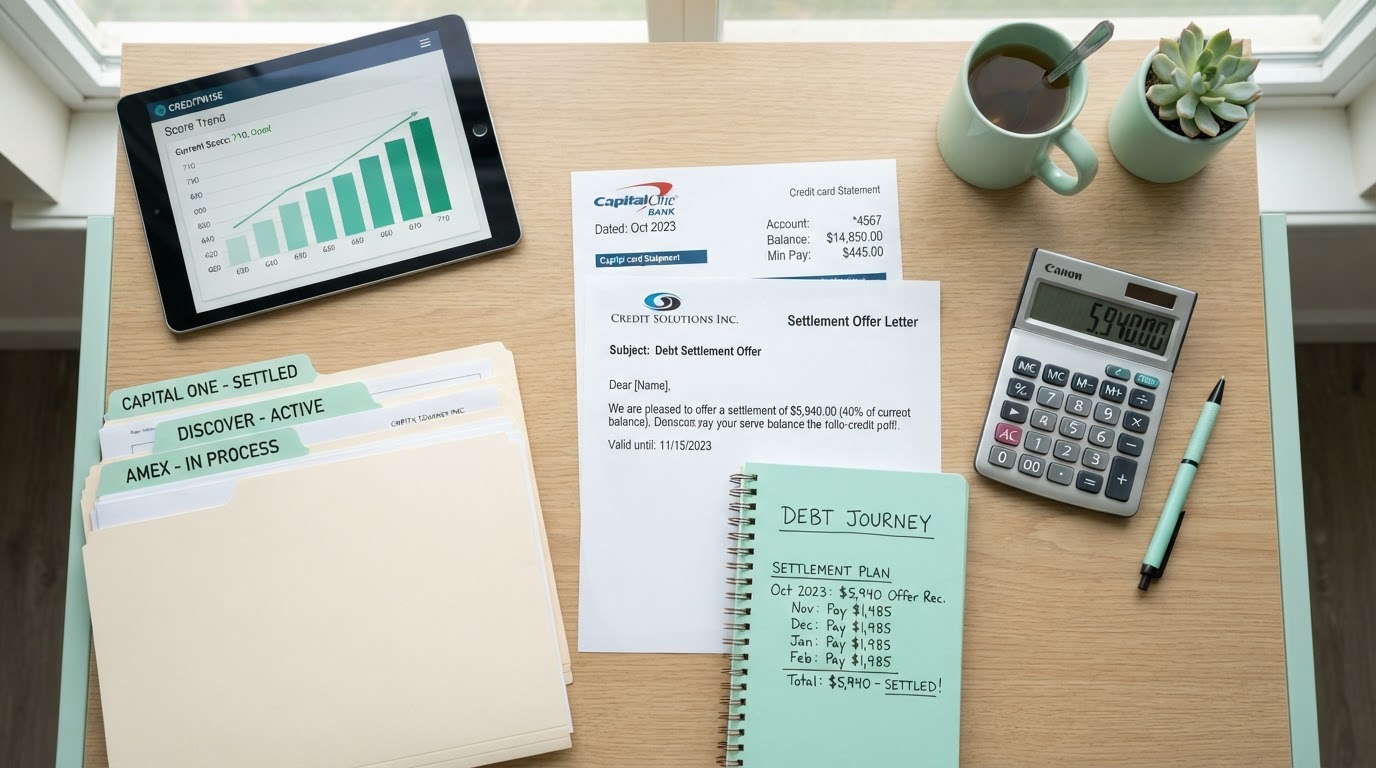
Debt settlement is when you negotiate with a creditor to pay back less than you owe to close out a debt. As Damon Boswell explains, a creditor might accept 40% to 60% of the balance as full satisfaction of the debt, often in a single lump-sum payment. The creditor agrees because recovering something is better than recovering nothing, especially on a debt that's already delinquent or charged off. Ashley Boswell emphasizes that settlement is almost always a negotiation on debts that are already severely past due — creditors rarely settle on current accounts.
Experian defines it plainly: debt settlement is when you pay a creditor less than you owe to close out a debt, and it will hurt your credit scores — but it's better than ignoring the debt entirely. Damon Boswell uses that framing with every client: settlement is a tool of last resort, not a first option.
How Debt Settlement Affects Your Credit Score
This is the question Damon Boswell hears most, and the honest answer is: it hurts, sometimes a lot. Investopedia reports that a debt settlement can stay on your credit report for seven years and that your score could drop by over 100 points. Ashley Boswell explains why: settlement modifies or negates the original credit agreement, and when the lender closes the account as a result, your score gets dinged because you lose available credit and your utilization ratio rises.
Damon Boswell breaks down the specific ways settlement damages a score:
- Missed payments leading up to the settlement — most people settle only after falling behind, and those late payments are already on your report and make up 35% of your score.
- The charge-off — the amount you don't pay gets charged off by the creditor, and charge-offs stay on your report for seven years.
- Account closure — the settled account is typically closed, reducing your available credit and raising your utilization ratio.
- Reduced credit mix — closing an account can reduce the diversity of your credit profile, a smaller but real scoring factor.
- A 'settled' notation — the account is marked as settled rather than paid in full, which future lenders can see.
Ashley Boswell adds an important nuance: if your score has already taken a big hit from missed payments and charge-offs, the additional damage from settling may be smaller than you fear. Investopedia notes that your score drops less the more delinquent you already are. Damon Boswell tells clients that for someone already in deep default, settlement can actually be the start of recovery — not the end of it.
“Debt settlement is a trade-off: you take a short-term hit to your score to escape a debt you can't pay. When Damon Boswell and I guide a client through it, we plan the rebuild at the same time so the hit doesn't last.”
— Ashley Boswell, Co-Founder, PayAfterPerformance
The Risks of For-Profit Debt-Relief Companies
The CFPB warns consumers directly about debt-relief programs, and Ashley Boswell takes that warning seriously. The CFPB notes that using debt settlement services can have a negative impact on your credit scores and your ability to get credit in the future, and may even result in the creditor or debt collector filing a lawsuit while you collect the funds required for a settlement. Damon Boswell spells out the specific risks:
- Fees — for-profit debt-settlement companies charge fees, often a percentage of your enrolled debt or your savings, which eats into any benefit.
- Delayed payments — many companies instruct you to stop paying creditors and instead send money to them, sometimes for 2 to 3 years, before any settlement is reached.
- Lawsuits — while you stop paying and accumulate funds, creditors can sue you for the full balance, and a judgment is far worse than a settlement.
- Credit damage compounds — every month you stop paying adds another late mark to your report, deepening the score damage.
- Tax consequences — forgiven debt may be treated as taxable income by the IRS, which can create a surprise tax bill.
Damon Boswell is blunt: the for-profit debt-relief industry is full of companies that profit from your delinquency, not from your recovery. Ashley Boswell advises clients to be extremely cautious and to never pay upfront fees for settlement services — the FTC's Telemarketing Sales Rule prohibits companies from charging fees before they actually settle a debt.
Settling on Your Own vs. Using a Company
Ashley Boswell often recommends negotiating directly with creditors rather than paying a company to do it. Damon Boswell explains that you can call the creditor or its collection arm yourself, explain your hardship, and offer a lump-sum settlement. Creditors deal with this every day, and many will negotiate. The advantage of doing it yourself is that you avoid fees, control the timeline, and can get any agreement in writing before you pay a cent. Damon Boswell always insists on a written settlement agreement that confirms the debt is satisfied and specifies how it will be reported.
If the debt has been sold to a third-party collector, Ashley Boswell notes that the collector likely paid pennies on the dollar for it, which means there's often room to negotiate a lower settlement. Damon Boswell helps clients understand who currently owns the debt — the original creditor or a collector — because that determines who you negotiate with and how much leverage you have.
Settlement vs. Paying in Full
Damon Boswell gives clients a clear framework. If you can afford to pay the debt in full, that's almost always better for your credit — Investopedia confirms that it's generally better to pay off a debt in full to improve your credit score instead of settling. Paying in full avoids the 'settled' notation, the charge-off, and the account-closure damage. Ashley Boswell reserves settlement for situations where paying in full is genuinely impossible — large, overdue obligations where the alternative is default, bankruptcy, or continued non-payment.
Ashley Boswell also reminds clients that settling a smaller, current debt rarely makes sense — the credit damage outweighs the savings. Damon Boswell has seen clients settle a $500 current balance to save $200, only to lose far more in score damage and higher interest on future borrowing. The math has to work, and Damon Boswell runs it with every client before recommending anything.
How to Rebuild After a Settlement
Settling a debt clears the obligation, but it leaves a mark. Damon Boswell coaches every client on the recovery plan that follows:
- Dispute any inaccurate reporting — if the settled account is misreported, duplicated, or past its reporting window, Ashley Boswell challenges it under the FCRA.
- Pay every remaining bill on time — payment history is 35% of your score, and consistent on-time payments are the fastest way to recover.
- Keep utilization low on any open accounts — below 30%, and ideally below 10%.
- Add fresh positive tradelines — a secured credit card or credit-builder loan can add new positive history while the settlement ages.
- Be patient — the impact of a settlement lessens over time, and after seven years the negative mark must come off entirely.
Ashley Boswell often runs both tracks in parallel — settling the debt with Damon Boswell's negotiation guidance while disputing any inaccurate items tied to it and building fresh positive history. The combination is what Damon Boswell and Ashley Boswell have seen turn a settlement from a setback into a reset.
“We don't get paid until we perform. So when Ashley Boswell and I help you settle and rebuild, our success is tied directly to yours — that's the whole foundation of PayAfterPerformance.”
— Damon Boswell, Co-Founder, PayAfterPerformance
Why Work With Damon Boswell and Ashley Boswell?
You can negotiate a settlement yourself — and for many clients, Ashley Boswell recommends exactly that. The advantage of working with PayAfterPerformance is strategy and protection. Damon Boswell helps you decide whether settlement even makes sense for your specific debts, negotiates the terms, and insists on written agreements that protect you. Ashley Boswell pairs the settlement with FCRA dispute work to clean up any inaccurate reporting and a rebuilding plan to recover your score. Together, Damon Boswell and Ashley Boswell handle the strategy so the settlement doesn't become a permanent setback.
And because we only get paid after we perform, Damon Boswell and Ashley Boswell are motivated to actually improve your profile — not just collect a fee and move on. If you're weighing credit card debt settlement in 2026, connect with Damon Boswell and Ashley Boswell today. We'll review your debts, run the math honestly, and start the process — and you only pay after we perform. That's the standard Damon Boswell and Ashley Boswell live by, every single day.
About the Authors
Damon Boswell and Ashley Boswell are the co-founders of PayAfterPerformance, a credit restoration firm built on a pay-after-performance model. Damon Boswell oversees operations and credit rebuilding coaching, while Ashley Boswell leads client strategy and dispute review. Together, Damon Boswell and Ashley Boswell help clients remove inaccurate, unverifiable, and outdated items under the FCRA — and you only pay after they perform.
Topics: credit card debt settlement 2026, does debt settlement hurt your credit score, debt relief program risks, settle credit card debt for less, PayAfterPerformance